Hand a beginner a dumbbell and a kettlebell side by side, and most women will reach for the dumbbell out of familiarity. That instinct usually changes within a single session.
The kettlebell moves differently. Its offset center of gravity forces the body to stabilize constantly, which is exactly why it builds strength, coordination, and core control simultaneously rather than isolating one muscle at a time. One piece of equipment, when used correctly, delivers a full-body training effect that most machine circuits simply can’t replicate.
Why This Tool Deserves A Real Place In Women’s Training
Kettlebells build lean muscle without adding bulk, which tends to matter to women specifically chasing a toned, functional look rather than mass. The combination of strength and cardio built into a single movement, a swing or a snatch, for instance, burns meaningful calories in less time than separating cardio and strength into two distinct blocks.
There’s real research behind the core benefit specifically. Studies published in the Journal of Strength and Conditioning Research have shown kettlebell swings activate the rectus abdominis and erector spinae significantly, making swings genuinely effective for core stability, not just an incidental side benefit.
And because most kettlebell movements are joint-friendly by design, no jumping, no repeated impact, they raise heart rate effectively while staying considerably easier on the joints than running or plyometric training.
Fifteen Movements Worth Learning Properly
Kettlebell Swing. Feet shoulder-width apart, hinge at the hips rather than squatting, and let the kettlebell swing between your legs before driving your hips forward explosively to bring it to chest height. This targets the glutes, hamstrings, and core, and it’s the movement most kettlebell training builds around.
Goblet Squat. Hold the kettlebell close to your chest, squat with your back straight and chest up, and push through your heels to stand. This builds genuine leg power while keeping the core engaged throughout.
Kettlebell Deadlift. Hinge at the hips with a straight back, lower the kettlebell toward the floor, then drive through your heels to return upright. Beyond building strength in the hamstrings and lower back, this movement teaches proper hip-hinge mechanics that carry over into nearly every other lift.
Kettlebell Shoulder Press. Press the kettlebell overhead from shoulder height with control, then lower it back down slowly. This is one of the more direct ways to build shoulder and tricep strength using a single kettlebell.
Kettlebell Row. Hinge forward with a slight knee bend, pull the kettlebell toward your hip while squeezing the shoulder blade, then lower with control. This strengthens the back and improves posture, something particularly relevant for anyone spending long hours at a desk.
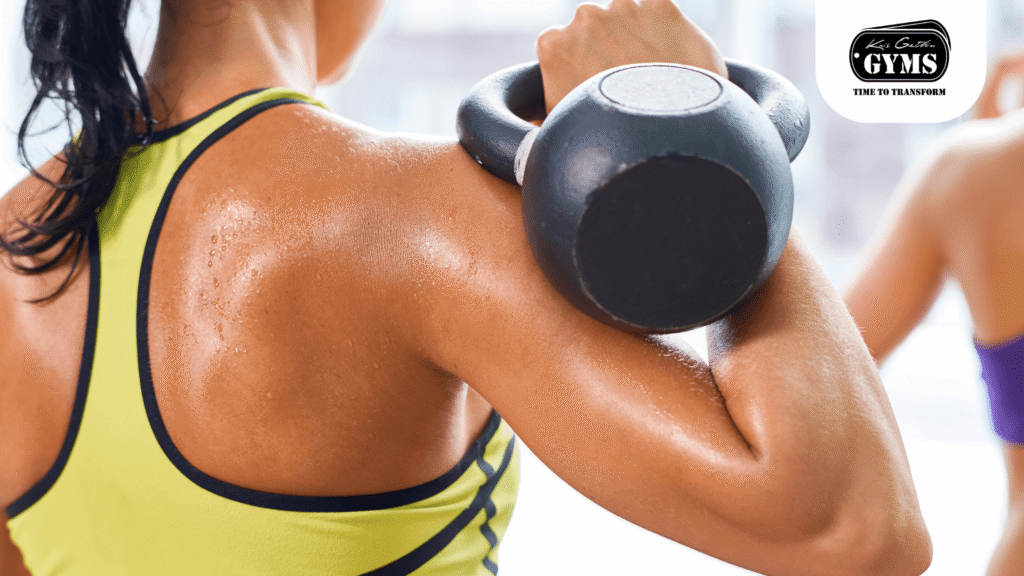
Kettlebell Clean. Swing the kettlebell up to shoulder height and catch it in the rack position with the elbow tucked close to the body. This teaches coordination and control that becomes foundational for more advanced movements like the snatch.
Kettlebell Lunge. Hold the kettlebell at chest height, step forward into a lunge with a tight core, then push back to standing. This builds leg strength while genuinely challenging balance in a way a stationary squat doesn’t.
Kettlebell Halo. Circle the kettlebell around your head slowly, engaging the core throughout, then reverse direction. A useful shoulder mobility movement that works well as a warm-up before heavier lifting.
Kettlebell Windmill. Hold the kettlebell overhead with one arm, bend at the waist reaching toward the opposite foot while keeping eyes on the kettlebell for balance. This builds core stability and flexibility together, targeting the obliques and hamstrings.
Kettlebell Snatch. Swing the kettlebell up to an overhead position in one continuous motion, keeping the arm straight and the core engaged. A high-energy movement that builds power and coordination once the swing and clean are well established.
Kettlebell High Pull. From a slight squat, pull the kettlebell up to shoulder height leading with the elbows. This builds shoulder and upper back strength while training explosive pulling power.
Kettlebell Farmer’s Carry. Hold a kettlebell in each hand, walk forward maintaining upright posture and a tight core. Deceptively simple, and one of the most effective ways to build grip strength and core stability at the same time.
Kettlebell Plank Drag. From a plank position, reach across and drag the kettlebell from one side to the other while keeping hips level. This challenges core stability and shoulder control simultaneously.
Kettlebell Russian Twist. Seated with knees bent and feet lifted, twist the torso to move the kettlebell side to side. A direct oblique and rotational core movement.
Kettlebell Thruster. Combine a squat with an overhead press, holding the kettlebell at shoulder height, squatting down, then driving up while pressing the kettlebell overhead. This works nearly the entire body in a single fluid movement, making it one of the most efficient exercises on this list.
Structuring A Full-Body Kettlebell Session
A well-balanced kettlebell workout doesn’t need dozens of exercises. It needs the right sequence across lower body, upper body, and core.
Start with lower body movements, the kettlebell swing and goblet squat build foundational strength and stability that the rest of the session builds on.
Move to upper body work next, the shoulder press and row strengthen the shoulders, arms, and back while improving posture. Finish with core-focused movements, the Russian twist and plank drag close out the session by targeting stability and balance directly.
Progression should track experience level honestly. Beginners get more value from two sets per exercise with a sharp focus on form than from rushing into higher volume before the movement pattern is solid. Intermediate lifters can move to three sets, adding reps as endurance builds.
Advanced lifters benefit from heavier kettlebells, four sets, and shorter rest periods to increase overall intensity.
Getting The Weight Selection Right From The Start
Choosing too heavy a kettlebell too early is one of the fastest ways to compromise form before strength has actually developed.
Beginners typically do best starting around 8 to 12 kg, focusing entirely on mastering the movement pattern before chasing load.
As confidence and technique solidify, increasing by 2 to 4 kg at a time keeps progression steady without outrunning what the body can control safely.
The real test isn’t whether you can lift a given weight, it’s whether you can lift it while maintaining full control through every phase of the movement.
More reps with a lighter, well-controlled kettlebell almost always builds more usable strength than fighting through a weight that breaks your form by the third rep.
The Technique Details That Actually Prevent Injury
Form matters more with kettlebells than with most other equipment, precisely because the offset weight distribution punishes sloppy mechanics faster than a barbell or machine would.
Keep the back straight and the core engaged throughout every movement, particularly during swings and deadlifts where the hip hinge pattern needs to stay clean.
Control the kettlebell at every phase, even in explosive movements like the swing, momentum should come from hip drive, not a wild, uncontrolled arc.
Breathing matters more than most beginners realize too, exhale on exertion, whether that’s the upward phase of a swing or the press overhead, and inhale as you reset the movement. Holding your breath through a rep creates unnecessary tension and accelerates fatigue.
Rest periods should scale with experience. Beginners generally need 45 to 60 seconds between sets to reset form properly, while advanced lifters can shorten that to 20 to 30 seconds for a more intense session.
And regardless of experience level, kettlebell training doesn’t need to happen daily. Muscles need 24 to 48 hours to recover between intense sessions, and building in one to two rest days weekly protects against burnout while actually supporting better long-term progress.
Why This Approach Fits Into A Bigger Training Picture
One thing coaches notice consistently with women who commit to kettlebell training seriously: the confidence that builds alongside the strength tends to carry into every other part of their training.
That’s precisely why kettlebell work gets woven naturally into programming at KRIS GETHIN GYMS, not as a standalone trend, but as a legitimate tool for building functional strength, coordination, and core stability that supports everything else on the training floor.
A single kettlebell, used with proper form and sensible progression, genuinely delivers results that rival a much larger equipment setup, provided the technique stays disciplined and the loading stays appropriate to where you actually are in your training.