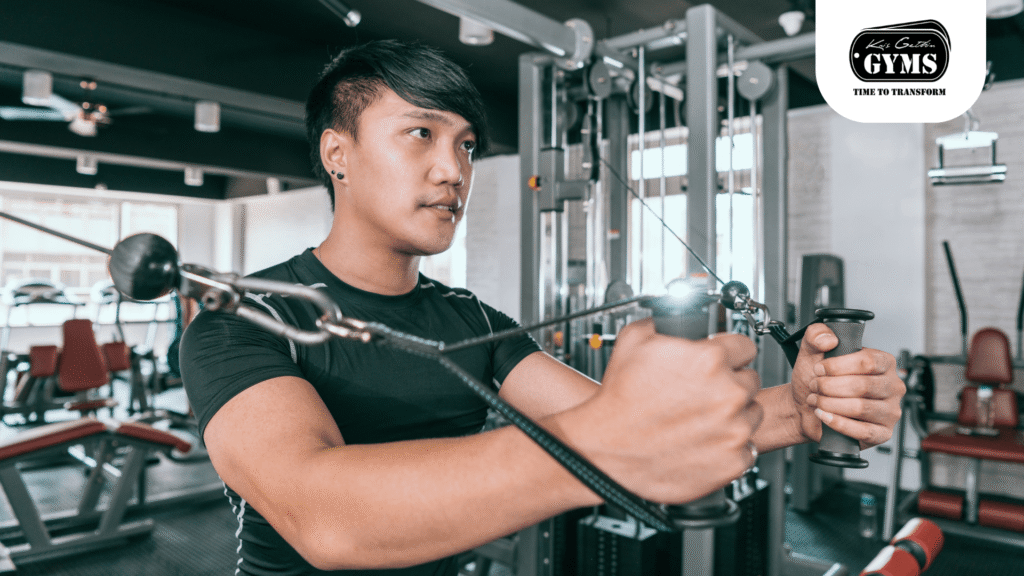
Watch someone turn a cable fly into a cable press, elbows bending and extending instead of staying fixed, and you’ll understand exactly why so many lifters never actually feel their chest working on this exercise.
That’s the most common failure point with the standing cable fly, and it’s a shame, because done correctly, this movement does something a barbell or dumbbell simply can’t replicate.
Unlike free weights, which lose tension at the top of the lift the moment gravity stops pulling directly against the muscle, cables maintain resistance through the entire arc, stretch, squeeze, and return, keeping the chest genuinely working the whole way through rather than coasting at the top of every rep.
What The Standing Cable Fly Actually Does
The standing cable fly is an isolation movement built specifically around the pectoralis major, the large chest muscle responsible for bringing the arms together in front of the body.
Using a dual-pulley cable system, the exercise delivers continuous resistance across the full range of motion rather than the inconsistent tension curve that free-weight fly variations tend to produce.
Worth clearing up a common confusion here, the cable fly and cable crossover aren’t identical. The fly maintains a fixed elbow bend throughout, moving only at the shoulder joint, while the crossover allows the hands to cross at the finish. Small distinction, meaningfully different feel.
The Muscles Genuinely Doing The Work
The pectoralis major itself breaks into three distinct regions, the clavicular head covering the upper chest, the sternal head covering the middle, and the costal head covering the lower portion.
Adjusting cable height shifts emphasis between these regions directly, and research published in the Journal of Strength and Conditioning Research found that exercises performed at roughly a 30-degree incline meaningfully increase activation in the upper, clavicular portion of the chest specifically. A low-to-high cable fly essentially recreates that same angle, making it a genuinely useful tool for anyone chasing upper chest development.
The anterior deltoids and triceps brachii assist throughout the movement, helping with arm adduction and overall stabilization, though keeping them supportive rather than dominant is exactly what preserves genuine chest isolation.
And because this exercise is performed standing, the core, rectus abdominis and obliques specifically, engages continuously just to maintain posture and prevent sway.
Research from Santana and colleagues confirmed that standing cable presses and fly variations demand real neuromuscular coordination from the core, making this genuinely a stability exercise as much as a chest-isolation one.
Why This Exercise Earns Its Place In Serious Chest Program
- Constant tension across the full range of motion is the defining advantage here. ACE-sponsored EMG research found cable movements activate up to 93% of the pectoralis major, compared to a one-rep max barbell bench press, a genuinely striking number for what many lifters treat as a secondary, finishing exercise rather than a serious training tool.
- Joint-friendly resistance matters considerably for long-term shoulder health. The cable’s natural rotation path minimizes joint stress in a way a fixed barbell path can’t match, making it a genuinely sensible option for anyone managing shoulder discomfort or simply looking for a safer isolation alternative to heavy pressing.
- Improved mind-muscle connection develops naturally from the slow, controlled tempo this exercise demands. Rushing a cable fly defeats its entire purpose, the deliberate pace is what actually builds genuine chest awareness alongside size.
- Core engagement comes built into the standing position itself, translating into better posture and stronger overall force transfer beyond just chest development.
- Adaptability across fitness levels rounds out the case. Beginners can master the movement pattern with light resistance, while advanced lifters push intensity through heavier loads or single-arm variations that add a genuine anti-rotation demand.
Setting Up And Executing The Movement Correctly
Setup: Set both pulleys to shoulder height. Select a moderate weight allowing 10 to 15 controlled repetitions. Grab each handle and step forward into a staggered stance for genuine stability.
Execution: Maintain a slight, fixed bend in the elbows throughout, with the core braced. Bring the arms together in a wide arc, feeling a genuine stretch through the chest at the starting position. Squeeze the chest hard at the center point before slowly returning to the start, never letting the weight stacks crash on the way back.
Coach’s cue: Imagine the feet rooted firmly to the floor. Engage the glutes and abdominals deliberately to eliminate sway, ensuring the chest, not the lower back or shoulders, is what’s actually driving the movement.
The Mistakes That Quietly Undermine This Exercise
Turning the fly into a press, bending and extending the elbows rather than keeping the arm angle fixed, is the single most common error and the one that undoes the entire point of the exercise. Overstretching the shoulders past a gentle chest stretch, chasing range of motion at the expense of joint safety, is another. Using momentum instead of controlled tension defeats the exercise’s core advantage entirely. Poor posture, letting the chest drop and shoulder blades round forward, shifts stress away from the target muscle. And uneven pulley height between the two sides creates asymmetrical tension that quietly builds imbalance over time.
Variations Worth Knowing
- Low-to-high cable fly targets the upper chest specifically, pulleys set low, handles moving upward through the arc, closely mimicking an incline dumbbell press’s activation pattern.
- Mid-pulley fly delivers balanced engagement across the sternal, middle portion of the chest, the standard version most lifters default to.
- High-to-low cable fly shifts focus to the lower chest, pulleys set high, handles moving downward, echoing a decline press. Single-arm cable fly adds a genuine anti-rotation core demand, forcing the torso to resist twisting throughout each rep.
Why Cables Outperform Dumbbells For This Specific Movement
Research comparing muscle activation in barbell presses and dumbbell flys found that fly movements using free weights produce meaningfully lower tension at the top of the lift, simply because gravity stops pulling directly against the chest once the arms approach full extension overhead.
Cables sidestep this limitation entirely by maintaining horizontal resistance throughout, resulting in genuinely greater time under tension. In practical terms, that translates into stronger isolation and better hypertrophy stimulus compared to the equivalent dumbbell version.
Programming The Standing Cable Fly
| Training Level | Sets × Reps | Rest | Frequency |
|---|
| Beginner | 3 × 12–15 | 60 sec | 2 days/week |
| Intermediate | 4 × 10–12 | 75 sec | 2–3 days/week |
| Advanced | 4 × 8–10 with drop set | 90 sec | 2–3 days/week |
Placing the standing cable fly after compound movements like the incline or barbell bench press pre-exhausts the chest at the end of a session, maximizing pump and definition once the heavier strength work is already complete.
Training Safely
Warming up with dynamic shoulder stretches before loading the cables matters more here than lifters often assume, given how much this movement depends on shoulder mobility. Avoiding a fully locked elbow position protects the joint from unnecessary strain, and keeping the motion controlled rather than chasing heavier and heavier loads preserves the exercise’s actual purpose. If shoulder discomfort shows up during this movement, a pec deck machine offers a genuinely useful guided-motion alternative worth switching to temporarily.
Where This Fits Into A Complete Chest Program
The standing cable fly earns its place as a finishing, isolation-focused movement, not a replacement for genuine compound pressing. For raw strength and overall size, the bench press and its variations remain the foundation.
For definition, isolation, and genuinely deep muscle engagement through a full range of motion, the cable fly delivers something pressing alone simply can’t.
This is exactly the layered approach coaches at KRIS GETHIN GYMS build into serious chest programming, heavy compound work first, controlled isolation work like the cable fly to finish, rather than treating either as a standalone solution on its own.