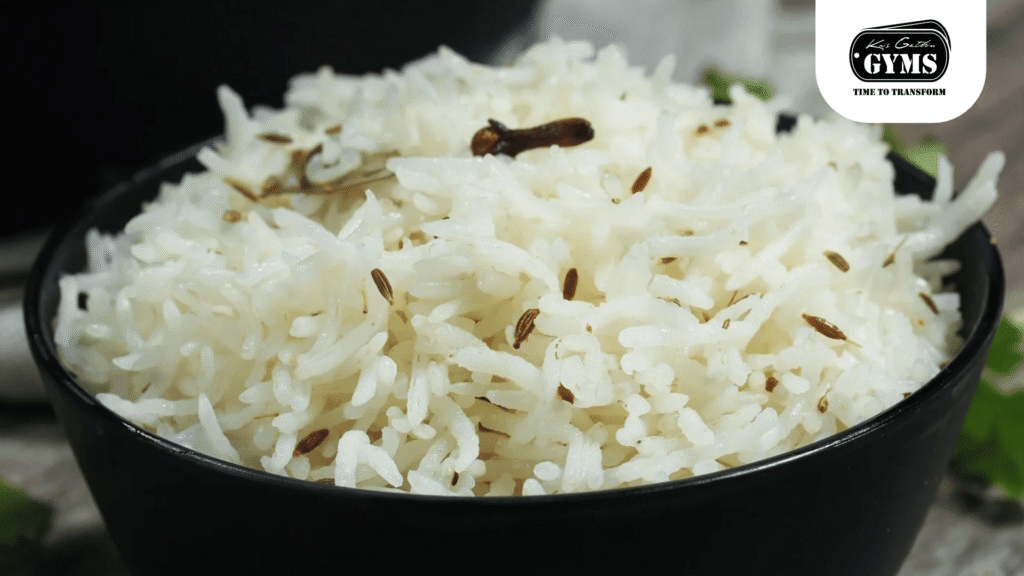
Someone decides to lose weight, and the first thing to go is rice. In its place come three rotis, or an expensive bowl of imported quinoa that nobody in the family actually enjoys.
Three weeks later, the craving for a proper rice meal wins, a plate of biryani follows, and the verdict gets delivered in the same breath: no willpower.
Coaches at KRIS GETHIN GYMS hear this story more often than almost any other, and it is almost always built on a misunderstanding.
Rice isn’t what makes anyone gain weight. Unmeasured portions eaten in a calorie surplus do that, and rice just happens to be the most visible thing on the plate.
Raw Vs Cooked Rice : The Mistake Behind Most Tracking Errors
The most common error when counting rice calories is mixing up raw weight with cooked weight. They are very different numbers.
Rice absorbs roughly 2.5 to 3 times its own weight in water while cooking, and water carries zero calories. So 100 grams of cooked rice contains far fewer calories than 100 grams of dry grains.
In practice, 100g of raw rice (around 350 to 360 kcal) cooks into roughly 280 to 300g of finished rice, with the same 350 to 360 kcal spread across a much larger volume. That makes 100g of cooked rice only about 125 to 130 kcal.
This matters most for anyone logging food in an app. Weigh rice before cooking and select the “raw” entry, or weigh it after cooking and select “cooked.” Mixing the two can throw a day’s numbers off by a few hundred calories without anyone noticing.
Calories in Rice By Variety (Per 100g Cooked)
| Rice Variety | Calories | Carbs (g) | Protein (g) | Fat (g) | Fiber (g) | Glycemic Index |
|---|
| White basmati | 121 kcal | 26.0 | 3.0 | 0.4 | 0.6 | 50-58 (medium-low) |
| Standard white (Sona Masoori) | 130 kcal | 28.2 | 2.7 | 0.3 | 0.4 | 70-72 (high) |
| Brown rice | 112 kcal | 23.5 | 2.6 | 0.9 | 1.8 | 55-60 (medium) |
| Parboiled / Usna | 123 kcal | 26.5 | 2.8 | 0.4 | 1.2 | 50-55 (low-medium) |
| Black / wild rice | 101 kcal | 21.3 | 4.0 | 0.3 | 2.2 | 45 (low) |
The spread between the lowest and highest variety here is under 30 calories per 100g. Variety changes the picture slightly. Portion size changes it dramatically.
What Everyday Indian Servings Actually Contain
Almost nobody weighs lunch on a kitchen scale. Here is what common serving sizes translate to in cooked white rice :
| Serving | Approx. Cooked Weight | Calories |
|---|
| 1 standard Indian katori | 100-120g | 130-155 kcal |
| 1 standard measuring cup | 150-160g | 190-205 kcal |
| 1 medium restaurant rice bowl | ~200g | ~260 kcal |
| 1 full dinner plate | 300-350g | 390-455 kcal |
When someone says rice makes them gain weight, the rice itself is rarely the real issue. The pattern usually looks like a 350g plate (around 450 calories) buried under an oily curry (another 300 or so), eaten without anyone registering the combined load.
The rice gets blamed because it takes up the most space on the plate, while the oil quietly does a good share of the damage.
White Rice Vs Brown Rice : Does Switching Actually Help?
The calorie gap between cooked brown rice (112 kcal per 100g) and cooked white basmati (121 kcal per 100g) is under 10 calories per serving. That is not a weight loss strategy.
What brown rice does offer is slightly more fiber (1.8g against 0.6g per 100g), along with a little more magnesium and phosphorus, since it keeps the bran and germ. What it can cost is comfort. Some people experience bloating or digestive discomfort from the insoluble fiber and phytic acid in brown rice, and a plan that causes daily discomfort rarely survives past the second week.
So the practical rule is simple. If brown rice suits you, eat it. If you prefer white basmati or Sona Masoori, there is no need to switch. Controlling the portion, and pairing white rice with vegetables and protein, slows digestion and moderates blood sugar rise just as effectively as the swap would.
Basmati Vs Sona Masoori : A Small But Real Difference
Basmati generally carries a higher amylose content, which gives it a lower glycemic index (roughly 50 to 58) compared with short and medium-grain Sona Masoori (around 70). In everyday terms, basmati digests slightly more slowly and tends to keep hunger away for a little longer.
That is a genuine edge, but a modest one. Someone who loves Sona Masoori and eats a measured katori with dal and vegetables will do better than someone who forces down basmati in a heavy portion because it sounded healthier.
Three Rules For Eating Rice On A Fat Loss Plan
1. Build the plate around rice, not just rice. A bowl of rice with only rasam or thin dal leaves protein and fiber far too low. A workable structure is roughly one cup of rice alongside one cup of dense protein (chicken breast, paneer, soya, eggs) and one cup of green vegetables or cucumber salad. The protein and fiber slow gastric emptying and keep hunger quiet for longer.
2. Cool the rice before eating it, if it suits your routine. Cooking rice and refrigerating it for a few hours increases its resistant starch, which behaves more like soluble fiber, feeding gut bacteria and lowering the effective calories absorbed. Reported reductions run around 10 to 15%, though the effect varies between people. Reheating the rice afterwards doesn’t erase the benefit, and it is a free adjustment for anyone already cooking in batches.
3. Measure the portion, at least for the first two weeks. Weigh or measure the cooked rice using your own katori for a few days, then learn what that portion looks like. After that, the eye gets accurate surprisingly fast, and the logging effort drops away. This single habit does more for results than any rice swap ever will.
What A Typical Dal-Rice Meal Actually Adds Up To
A standard home-cooked portion of one cup of cooked rice (150g, about 195 kcal) with a medium katori of toor dal cooked with a teaspoon of ghee (about 160 kcal) lands around 355 to 380 calories.
That is a perfectly reasonable meal inside most fat loss targets, and it delivers protein, carbohydrate, and a bit of fat in a form most Indian households already know how to cook well.
The meal only becomes a problem when it quietly doubles, a second helping of rice, extra ghee on top, a side of fried papad, and the original 380 becomes 800 without anyone deciding it should.
Why Rice Deserves Better Than Its Reputation
For most Indian clients, rice is not the obstacle. It is the foundation of meals they enjoy and will keep eating for decades, which makes it a far better thing to manage than to ban.
Removing a staple food produces the exact cycle described at the start of this article: restriction, craving, rebound, guilt.
The approach we build into nutrition guidance at KRIS GETHIN GYMS is the opposite. Keep the foods people love, measure the portion honestly, pair it with protein and vegetables, and let the total calories for the day do the deciding.
Weight loss responds to your overall intake across the week. It doesn’t respond to whether a single ingredient appeared on the plate.