Every gym owner who’s opened a second location will tell you the same thing about their first one. They didn’t realize how many decisions had already been made for them the moment they placed their first equipment order.
A missing licence surfaces during a fire inspection three weeks before launch. A treadmill count based on guesswork instead of member projections creates a queue every morning at 7 AM.
A flooring choice made to save a few lakh rupees turns into a warped subfloor within a year. None of these mistakes come from bad intentions.
They come from opening a gym without a sequence, buying equipment before defining the concept, and hoping the compliance paperwork sorts itself out later.
Opening a gym in India in 2026 is a fundamentally different undertaking than it was five years ago. Members walk in already having researched competing facilities, watched fitness content for months, and formed clear expectations about what a well-equipped gym should feel like.
The Indian gym equipment market alone reached USD 630 million in 2024, growing at a projected 8.10% annually through 2033, which means more gyms are opening every year, and your equipment list is one of the clearest signals members use to decide whether they’re staying with you or walking down the road.
Answer These Four Questions Before You Buy Anything
Most equipment guides start with machines. That’s backwards.
Before a single purchase order goes out, define exactly who you’re building for. Who is your target member, beginners, bodybuilders, working professionals, senior citizens, or a general-fitness mix? How many active members do you realistically expect during peak hours? What’s your total workout floor area? And will the facility offer personal training, group classes, or both?
These four answers determine everything downstream, your equipment mix, zone layout, and quantities. A gym built for general fitness members needs a completely different cardio-to-strength ratio than a powerlifting-focused facility or a group-training studio. Skipping this step is how gyms end up with six treadmills nobody uses and a free-weight zone too cramped to actually train in.
Once the concept is defined, draw the floor plan before ordering equipment. A cardio zone with 10 treadmills, 6 bikes, and 4 rowers typically needs 100 to 130 square metres.
A free-weight zone built for 10 simultaneous users needs another 80 to 120 square metres. Factor in 10 to 20 square feet of clearance per machine or active user across the entire floor, and mark out your zones, cardio, strength, free weights, functional training, stretching, before equipment starts arriving.
The Legal Clearances That Cannot Wait Until Launch Week
Running a commercial gym in India requires a specific set of registrations, and two of them are genuinely non-negotiable before opening day.
Business registration comes first, whether as a sole proprietorship, partnership, LLP, or private limited company.
The Shop and Establishment Act licence, obtained from your local municipal corporation, functions as the primary gym licence in India and is mandatory for any commercial premises.
GST registration applies once annual turnover crosses ₹20 lakh, or ₹10 lakh in North-Eastern states.
A Fire Safety NOC, issued by the state fire department after physical inspection, is required for every commercial gym setup without exception.
Round this out with a trade licence from the local municipal body, a music licence under the Copyright Act if you play music during sessions or classes, professional tax registration once you employ staff, and EPF and ESI registration once staff counts cross 20 and 10 employees respectively.
The Fire Safety NOC and Shop and Establishment licence specifically should never be treated as paperwork to sort out after opening. These are the two clearances that regulators actually check first, and operating without them puts the entire business at risk from day one.
Building The Facility Around The Equipment, Not Just Placing It
Equipment only performs as well as the facility supporting it, and flooring is where this shows up fastest.
Rubber tiles or rolls, 8mm to 12mm, belong under all cardio and strength machines.
The free-weight zone needs thicker rubber flooring, 15mm or more, given the repeated impact of plates and dumbbells hitting the ground.
Foam or EVA tiles are appropriate only in the stretching and warm-up zone. Marble, ceramic tiles, or polished concrete have no place under gym equipment at any point on the floor.
Electrical capacity deserves equal attention. A floor running 10 treadmills alongside multiple ellipticals can draw 30 to 60 amps under simultaneous load, which means dedicated circuits and surge protection aren’t optional extras, they’re what stands between a functioning gym and a blown circuit during peak hours.
Ventilation and climate control matter just as much, an HVAC system holding 18°C to 22°C during peak usage, with airflow strong enough to prevent dust buildup, which happens to be one of the leading causes of cardio machine motor failure in Indian gyms specifically.
Safety infrastructure rounds out the facility checklist: mounted and tagged fire extinguishers, clearly marked and unobstructed emergency exits, first aid kits at multiple points on the floor, safety signage at every equipment zone, and CCTV coverage across the entire workout area.
Cardio Equipment : What Members See First
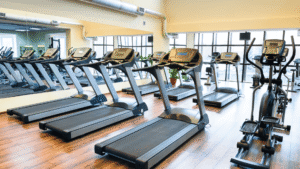
Cardio machines set the first impression, and because they run continuously throughout the day in a commercial setting, durability matters more here than almost anywhere else on the floor.
Treadmills follow a rough guideline of one unit per 30 to 40 active members, meaning a mid-size gym of 200 to 400 members typically needs 6 to 10 units, each with a 3.0 to 4.5 CHP motor and genuine commercial-use rating, home-grade motors simply won’t survive commercial load for more than a few months.
Elliptical trainers, 4 to 6 units, serve low-impact users, older members, and anyone managing knee sensitivity. Upright bikes, 4 to 6 units, and recumbent bikes, 2 to 4 units, cover both general cardio training and members needing back support.
Air bikes, 2 to 4 units, offer a genuine durability advantage since the fan-resistance mechanism has no motor to maintain. Air rowers, 2 to 4 units, engage roughly 86% of the body in a single stroke and tend to attract a dedicated user base once members discover them. Steppers round out the category, compact and low-maintenance, at 2 to 4 units.
Strength Training : Selectorised And Plate-Loaded Coverage
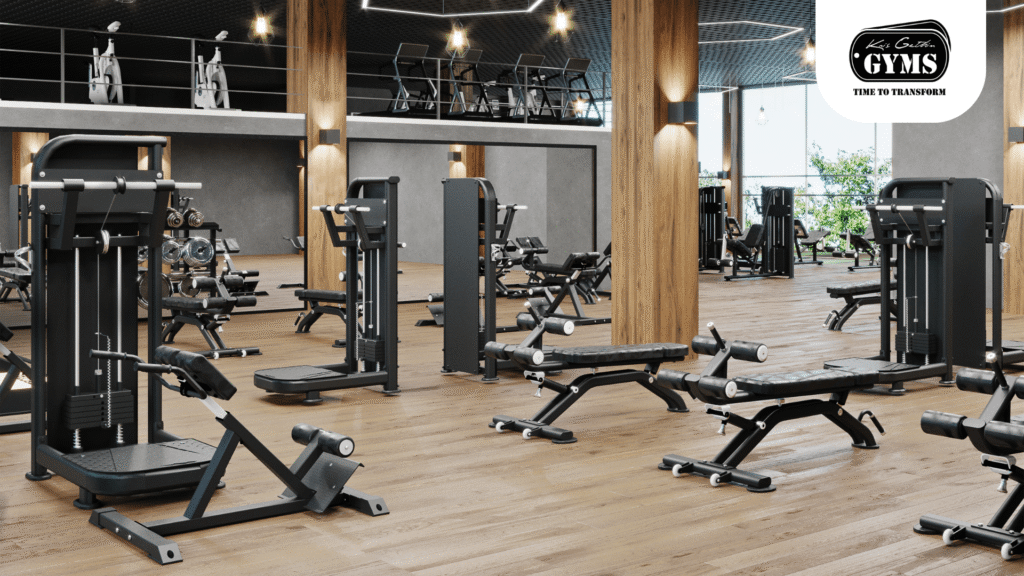
Selectorised, pin-loaded machines form the starting point for most members and need to cover every major muscle group.
That means chest press, lat pulldown or seated row, shoulder press, leg press at two units given demand, leg extension, leg curl, cable crossover or functional trainer, abdominal crunch, and back extension, each represented at minimum quantity across the floor.
Plate-loaded equipment serves the more experienced lifter base wanting a natural range of motion.
A Smith machine, plate-loaded chest press, T-bar row, and, budget permitting, a plate-loaded leg press alongside the selectorised version, give advanced members the training options that keep them from outgrowing your facility within a year.
Free Weights : The Zone No Gym Can Skip
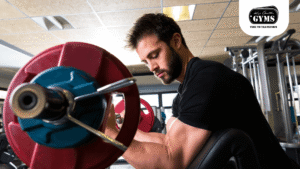
No machine replicates the full-body stabilization demand of genuine dumbbell and barbell training, which makes this section non-negotiable regardless of budget constraints elsewhere.
A complete dumbbell set from 2.5kg to 50kg in 2.5kg increments is the baseline for a mid-size commercial gym, ideally in rubber hex form for durability and noise control, stored on a properly fitted three-tier rack with 2 to 3 metres of open floor clearance in front for safe lifting.
Barbells need 4 to 6 Olympic units at 20kg plus 2 to 4 women’s Olympic bars at 15kg, paired with rubber-coated plates across the full range from 25kg down to 1.25kg.
Benches and racks round out the zone: 2 to 4 flat benches, 2 to 3 adjustable incline or decline benches, and 2 to 3 power or squat racks, each needing roughly 3m by 2.5m of clearance including space for the lifter to step back safely.
A kettlebell set from 8kg to 32kg in 4kg increments, two of each weight, completes the free-weight zone.
Functional Training : Where Modern Indian Gyms Are Actually Growing
Functional training has seen genuine growth in Indian commercial gyms recently, particularly in urban facilities where members increasingly want performance-based, movement-driven training over isolated machine work.
A multi-jungle or functional training rig anchors this zone, integrating pull-up bars, battle rope anchors, and suspension trainer mounts into a single structure. Add a functional trainer with dual adjustable cables, one to two battle rope sets, a range of medicine balls from 3kg to 10kg, a resistance band set across five resistance levels, plyometric boxes in three heights, and suspension trainers if group classes are part of the offering.
The Accessories That Members Notice When They’re Missing
Nobody gets excited about a foam roller the way they get excited about a new treadmill, but their absence gets noticed fast.
Exercise mats, foam rollers, light resistance bands, stability balls, and ab wheel rollers cover the warm-up and floor zone.
Sanitiser dispensers positioned roughly one per four to five machines, disinfectant spray safe for rubber and PU leather, and dedicated waste bins across the cardio, free-weight, and reception areas handle hygiene.
Storage racks, cable attachment hooks, and mirror walls along the strength and free-weight zones round out the accessory list, small investments that shape whether the facility feels genuinely finished or perpetually half-built.
Maintenance Planning Before Day One, Not After The First Breakdown
A gym opening without a maintenance plan already in place is one service call away from a genuine member experience problem.
Before signing with any equipment supplier, confirm frame warranty length, ideally lifetime or a minimum of 5 years on welded frames, motor warranty on cardio units, typically 3 to 5 years on commercial-grade machines, parts warranty coverage, on-site service availability in your specific city, and realistic response times for service requests. Spare parts availability within India matters considerably more than it sounds, since a machine down for three weeks waiting on an international shipment is a machine actively costing you member trust.
From there, build a maintenance rhythm into daily operations. Daily checks cover surface wipe-downs, treadmill emergency stop clips, and unusual machine noise. Weekly maintenance handles belt alignment, cable inspection for fraying, and loose bolt checks on benches and racks. Monthly service covers motor inspection and bearing lubrication, while a full professional service every six months should include belt replacement assessment and internal motor cleaning.
Setting aside 2 to 5% of monthly revenue as a standing maintenance budget consistently proves to be one of the highest-leverage operational decisions a gym owner can make, extending equipment life far more effectively than reactive repairs ever will.
Why This Sequence Actually Matters
The gyms that struggle in their first year rarely fail because of one bad decision. They fail because equipment got purchased before the concept was defined, licences got treated as an afterthought instead of a launch prerequisite, and maintenance never made it into the opening budget at all.
This is precisely the kind of operational discipline that separates a facility members trust from one they quietly stop renewing at, and it’s the same standard our team applies when planning out new KRIS GETHIN GYMS locations, sequence first, equipment second, and a maintenance plan built in from day one rather than bolted on after the first breakdown.