Weigh your chicken cooked, log it as raw, and your day’s protein is off by roughly a third. It is the quietest way to wreck a deficit or a surplus, and it happens in kitchens across India every evening.
Our coaches at KRIS GETHIN GYMS see it often with clients who train hard, eat “plenty of chicken,” and still stall. The chicken was never the problem. The tracking entry was.
One piece of meat can legitimately read 22.5g or 31g of protein per 100g depending on when it hit the scale, and both numbers are correct.
Why Chicken Weighs Less After Cooking
Heat does not create protein, and normal cooking does not destroy it. What heat changes is the water.
Raw chicken muscle is roughly 70 to 75% water. When the meat reaches the standard safe internal temperature of around 75°C, it loses a large share of that moisture.
Research on meat cooking puts the juice loss at roughly 33 to 38% at that temperature, while ordinary grilling or roasting of boneless, skinless breast typically trims the scale weight by about 25%.
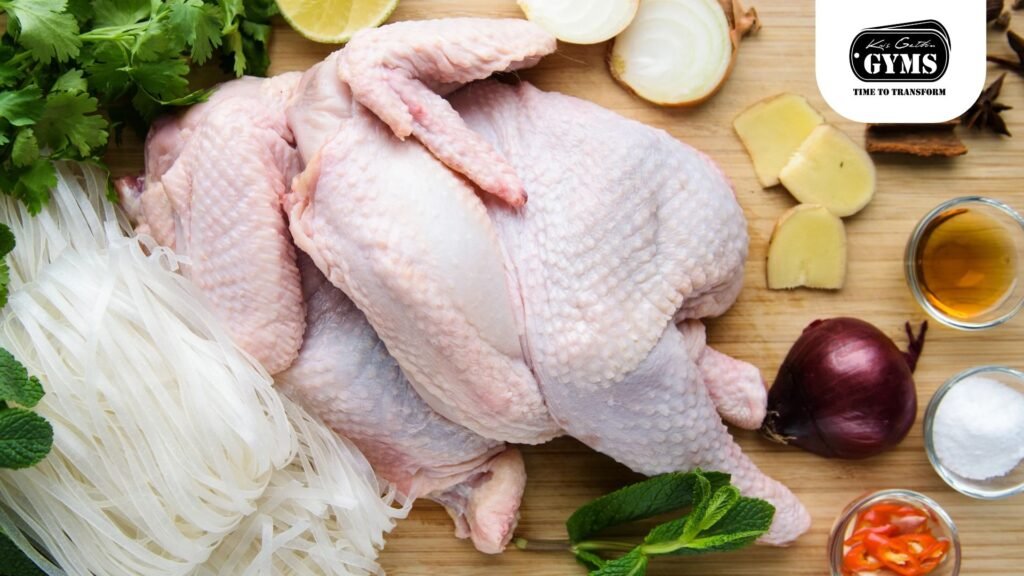
Here is what that looks like in practice. Put 100g of raw breast on the grill. It contains about 22.5g of protein. After cooking it weighs roughly 73 to 75g, but it still holds the same 22.5g.
Now keep adding cooked pieces until the scale reads 100g. You are holding about 31g of protein, because you are weighing more muscle and less water. The protein did not multiply. The water left.
The Weighing Rule That Prevents Most Errors
Raw weight is the one constant. Cooking time, pan temperature, and moisture vary from day to day, so a cooked weight can drift by several grams depending on how long the chicken sat in the heat.
The protocol we use with clients is simple:
- Weigh the chicken raw, before any heat touches it.
- Log it using the raw database entry.
- If you batch-cook first and weigh later, multiply the cooked skinless breast weight by roughly 1.33 to estimate its raw equivalent.
Whichever method you pick, pick one and stay with it. Switching between raw and cooked entries mid-week is how clean logs turn into unreliable ones.
Raw Vs Cooked Chicken: Protein And Calories Per 100g
Do not use one generic “chicken” entry in your tracking app. Different cuts carry different amounts of protein, fat, and connective tissue. The values below come from USDA FoodData Central and the ICMR-NIN Indian Food Composition Tables.
| Chicken Cut | State (per 100g) | Protein (g) | Energy (kcal) | Fat (g) | Source |
|---|
| Breast, boneless, skinless | Raw | 22.5 | 120 | 2.6 | USDA |
| Breast, boneless, skinless | Cooked, grilled | 30.5 | 151 | 3.2 | USDA |
| Breast, boneless, skinless | Cooked, roasted | 31.0 | 165 | 3.6 | USDA |
| Breast, skinless (Indian poultry) | Raw | 21.8 | 168 | 9.0 | ICMR-NIN |
| Thigh, boneless, skinless | Raw | 19.7 | 144 | 7.3 | USDA |
| Thigh, boneless, skinless | Cooked, roasted | 24.8 | 179 | 8.2 | USDA |
| Drumstick, meat only, skinless | Raw | 19.3 | 116 | 3.8 | USDA |
| Drumstick, meat only, skinless | Cooked, roasted | 24.2 | 155 | 5.7 | USDA |
| Wings, meat and skin | Raw | 17.5 | 211 | 15.1 | USDA |
| Wings, meat and skin | Cooked, roasted | 23.8 | 254 | 17.1 | USDA |
| Liver (Indian poultry) | Raw | 21.6 | 124 | 2.1 | ICMR-NIN |
Two details in that table are worth slowing down for.
Indian and Western values differ. The ICMR-NIN entry for raw skinless breast shows 9.0g of fat per 100g, against 2.6g in the USDA entry. Bird size, feed, and how the meat is trimmed at the counter all play a part. Trim visible fat pads before weighing and your numbers will sit much closer to the leaner USDA figure.
Bone-in changes everything. The drumstick and wing values cover edible meat only. Bone makes up roughly 30 to 45% of the raw weight of bone-in pieces. Weigh the whole piece, strip the meat, weigh the bones, and subtract to find what you actually ate.
Does Cooking Change How Much Protein You Absorb?
Cooking affects how fast and how fully your body takes protein in, and the sweet spot is moderate heat.
Chicken is a complete protein with all nine essential amino acids, including leucine, the amino acid most linked to switching on muscle protein synthesis. Research on meat cooked at around 75°C found a true ileal digestibility of about 96%, which means nearly all the protein you log is absorbed.
Overcooking works against you. Studies comparing temperatures found that meat cooked at 95°C released amino acids into the bloodstream noticeably more slowly, with peak levels arriving after roughly 290 minutes compared with about 165 minutes at 75°C. Charring or boiling hard produces tougher meat and slower absorption.
The practical target is a core temperature of 74°C (165°F), in line with USDA food safety guidance. At that point the meat is safe, absorption is strong, and the texture stays tender. A cheap digital thermometer is the easiest way to hit it. Let the chicken rest covered for about five minutes before slicing so it reabsorbs its juices.
Portion Guide For Real Meals
Few people eat exactly 100g in one sitting. Use this table to scale quickly:
| Portion | Raw Breast (Protein / kcal) | Cooked Roasted Breast (Protein / kcal) | Raw Thigh (Protein / kcal) | Cooked Roasted Thigh (Protein / kcal) |
|---|
| 100g | 22.5g / 120 | 31.0g / 165 | 19.7g / 144 | 24.8g / 179 |
| 150g | 33.8g / 180 | 46.5g / 248 | 29.6g / 216 | 37.2g / 269 |
| 200g | 45.0g / 240 | 62.0g / 330 | 39.4g / 288 | 49.6g / 358 |
| 250g | 56.3g / 300 | 77.5g / 413 | 49.3g / 360 | 62.0g / 448 |
| 300g | 67.5g / 360 | 93.0g / 495 | 59.1g / 432 | 74.4g / 537 |
To put this against a target: the ICMR-NIN guidelines set a baseline of about 0.83g of protein per kilogram of body weight for a sedentary adult, which is roughly 54g a day for a 65 kg person. Active lifters chasing muscle gain or fat loss usually aim for 1.6 to 2.2g per kilogram. For an 80 kg lifter aiming at 160g a day, two meals of 250g raw breast deliver about 112g of protein, which is around 70% of the day’s target for roughly 600 calories.
How The Cooking Method Changes Your Numbers
Chicken breast starts with no carbohydrates and very little fat. What you do next decides the final macros.
- Grilling, air-frying, roasting: Dry heat needs no added fat. Expect about 30.5 to 31g of protein and 151 to 165 kcal per 100g cooked. A light spray or parchment prevents sticking.
- Poaching, steaming, boiling: The meat stays wetter, so 100g cooked sits closer to its raw weight and gives roughly 26 to 28g of protein, not 31g. If you poach or boil, weigh raw.
- Pan-searing in oil or ghee: One tablespoon (about 14g) of oil or ghee adds roughly 120 kcal and 14g of fat. Cook 100g of breast in a tablespoon of ghee and you have nearly doubled the calories without adding a gram of protein.
- Gravies and restaurant tandoori: Cream, cashew paste, refined oil, and buttery basting make restaurant chicken hard to track. At home, marinate in low-fat curd, lemon juice, ginger-garlic paste, turmeric, and dry spices to keep the macros predictable.
Five Habits That Keep Your Tracking Honest
- Buy a digital gram scale. Estimating a “medium breast” by eye can be off by as much as 30%.
- Pick one database standard. Raw or cooked, and stay with it.
- Read the label on frozen chicken. Some commercial breasts are injected with a 10 to 15% salt-water solution. If water and salt appear in the ingredients, your raw 100g holds noticeably less protein than plain chicken. Choose fresh or un-injected poultry where you can.
- Use a meat thermometer. Pull the chicken at 74°C and rest it for five minutes.
- Spread protein across the day. Three to four feedings, a few hours apart, work better than packing everything into one dinner.
Precision in the kitchen supports intensity in the gym. Weigh the food, respect what heat does to it, and let the numbers on your log reflect what you actually ate.