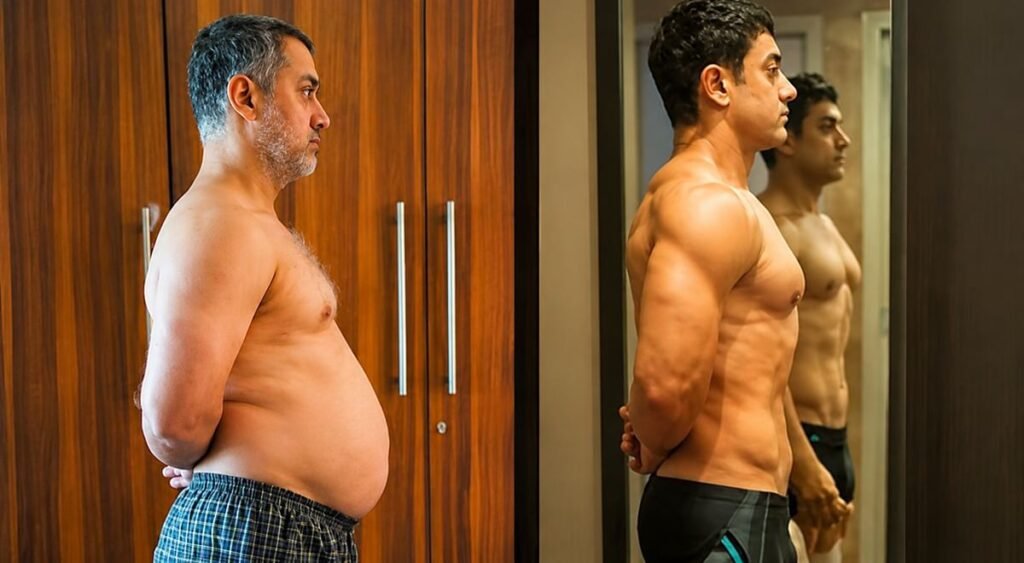
Almost ten years after Dangal released, the transformation is still the reference point every Indian actor gets measured against.
Most of the coverage focused on the before-and-after photographs. Very little of it looked at the part that actually mattered, the order the two bodies were built in.
That sequencing is worth understanding properly, because it’s exactly what separates a genuinely difficult piece of physical preparation from something that just photographs dramatically.
The Problem Was Never Losing Weight
Aamir Khan had to portray Mahavir Singh Phogat at two distinct points in the character’s life. An older, heavier, retired wrestler carrying a visible paunch.
And a younger, competitive wrestler carrying real muscle at low body fat. One actor, one shooting schedule, two bodies sitting at genuinely opposite ends of the composition spectrum.
Widely reported figures put him near 97 kilos at the heaviest point, dropping to close to 70 kilos for the wrestling sequences, with body fat falling from the high thirties into single digits. He was 51 years old throughout this process.
The decision that shaped everything was shooting the older scenes first, at peak weight, then cutting down toward the leaner physique.
That’s the harder direction to run. It’s also the correct one, since it removes the temptation to rush a gain, and it means the lean, competition-ready look lands at the very end of the schedule rather than needing to be held for months on end.
The Gain Phase Was Easier Than It Looks, And Worse Than It Looks
Putting on 25 kilos isn’t a technical nutrition challenge. Nearly anyone can do that part.
The actual challenge is doing it without wrecking the metabolic starting point for the phase that follows. Gain that much weight carelessly, and insulin sensitivity drops, inflammatory markers climb, sleep quality deteriorates, and joint loading during training becomes a genuine injury risk.
The body then has to strip that weight off from a starting position that’s quietly gotten worse at losing it in the first place.
So the gain had to be deliberately unglamorous. Weight went on, but blood markers stayed monitored throughout. Training never stopped.
Protein intake stayed genuinely high even during a surplus, since muscle retained during the gain phase is muscle that doesn’t need to be rebuilt from scratch later.
For a man in his early fifties, this discipline mattered more, not less. Recovery capacity is already narrower at that age, leaving considerably less margin to absorb a badly managed month.
The Real Work Sat in Phase Two
Dropping close to 30 kilos while retaining enough muscle to genuinely look like a competitive wrestler is the actual feat at the center of this transformation.
At 51, in a large calorie deficit, the body defaults to sacrificing muscle first, it’s simply the cheaper tissue to give up.
Every deliberate decision in this phase existed to make that default outcome less likely. Protein stayed high in absolute terms, not as a shrinking percentage of a falling calorie target.
Resistance training continued at meaningful loads rather than being replaced by hours of cardio, since training stimulus is precisely what signals to the body that muscle is worth preserving.
The deficit stayed aggressive but wasn’t open-ended, paced against real measurements rather than a fixed calendar date.
Sleep got treated as a genuine variable in this equation, not a luxury to sacrifice under schedule pressure. Sleep restriction during a deficit measurably shifts the ratio of fat lost versus lean mass lost, and film production schedules are structurally hostile to consistent sleep by their very nature.
The Part Almost Nobody Copies Correctly
Every year, people attempt some version of this transformation, and the failure pattern is almost always identical.
They copy the deficit and skip the structure surrounding it. Calories get cut hard, protein drops along with everything else, weight training gets replaced with an hour of cardio, and the scale becomes the only feedback anyone’s tracking.
Six weeks later, the number has moved, but body composition has moved in the wrong direction entirely. Lighter and softer, simultaneously.
The second failure is treating this as a copyable template. It was never that. This was a plan built for one specific person, at one specific age, with a known schedule, a known end date, and genuine daily supervision underneath it.
Regular medical monitoring sat beneath the entire process. That places it in a fundamentally different category from a diet plan found online and applied without any of that infrastructure.
What’s Actually Worth Taking From This
If there’s one genuine principle worth extracting, it’s the sequencing itself. Know which direction you’re actually running, gaining first or cutting first. Know your real end date rather than an open-ended goal.
And protect lean mass deliberately on the way down, through consistent protein, continued resistance training, and genuine attention to recovery, rather than treating the deficit as the only lever that matters.
This is exactly the principle our coaches at KRIS GETHIN GYMS emphasize with any client pursuing a serious body composition change, the deficit itself is rarely the hard part.
Protecting muscle while running it, particularly for anyone over 40 with genuinely narrower recovery margins, is where the actual skill and discipline live.
Everything else about this specific transformation, the exact numbers, the exact timeline, was built around one individual’s age, schedule, and medical profile. Those specifics were never meant to be replicated directly.