Some members walk straight past the machines and head for the squat racks without a second thought. Others barely touch a barbell because they’re convinced machines are safer and “better for muscle growth.”
Then there’s a third group. They bounce between both sides of the gym without really knowing why.
None of these approaches is entirely right – or entirely wrong. The problem is that fitness conversations often turn into debates when they should really be discussions about context.
Machines versus free weights has been one of bodybuilding’s longest-running arguments. Ask ten experienced lifters, and you’ll probably hear ten different opinions.
But muscles don’t grow because of opinions. They grow because they’re challenged in the right way, consistently, over time.
That’s exactly how we approach hypertrophy training at KRIS GETHIN GYMS Jalandhar.
Rather than asking members to choose one camp, we help them understand when each tool works best – and why combining both usually delivers superior results.
The Question Isn’t Which One is Better
It’s easy to assume that one method must be superior. After all, social media often presents fitness as an all-or-nothing decision.
Either you’re a “functional” athlete. Or you’re a bodybuilder.
Either free weights build real muscle. Or machines provide better isolation.
Reality is rarely that simple. Every piece of equipment on the gym floor exists for a reason. The challenge isn’t choosing between them.
It’s knowing where each fits into a well-designed workout. That’s a very different conversation.
Why Free Weights Have Never Lost Their Place
Walk into almost any serious bodybuilding gym around the world and you’ll hear the same unmistakable sounds.
Plates sliding onto barbells. Dumbbells being lifted from heavy racks. The clang of iron after a hard set.
There’s a reason free weights have remained central to strength training for decades.
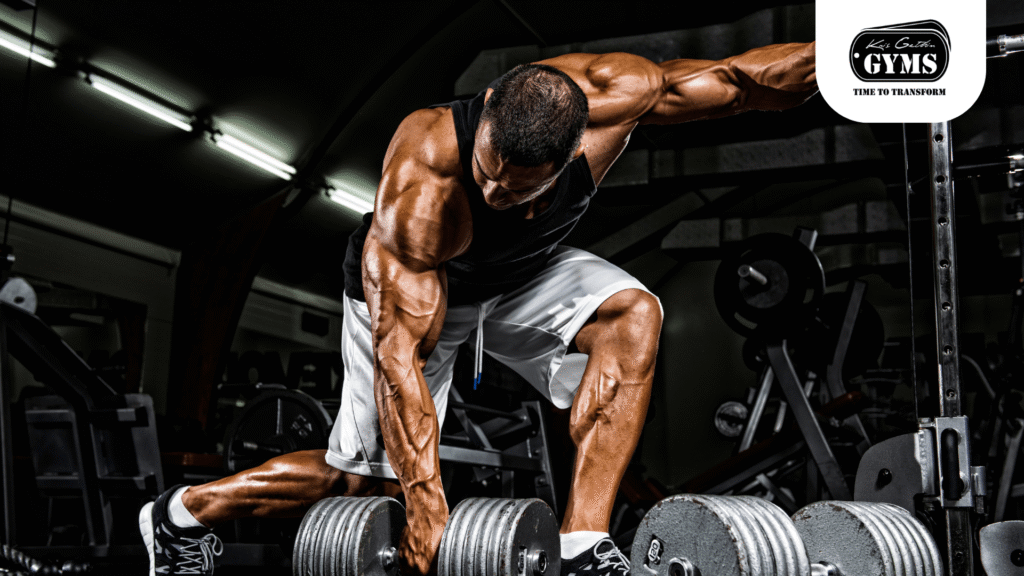
They ask more from your body. Take a simple barbell squat. Your legs obviously do most of the work.
But they’re not working alone.
Your core stabilises the movement. Your back keeps your torso upright. Your hips coordinate every repetition.
Even your feet are making constant adjustments to maintain balance. You’re not simply lifting weight. You’re controlling it.
That additional demand recruits more muscles and develops strength that carries over into everyday movement as well as athletic performance.
There’s something incredibly satisfying about mastering a heavy free-weight movement. It teaches patience, coordination and confidence all at once.
Every Body Moves Differently
One advantage of free weights that often gets overlooked is freedom.
Machines are designed around average body proportions. People aren’t.
Some members have longer arms. Others have shorter torsos.
Hip structure, shoulder mobility and limb length vary enormously from person to person.
A dumbbell press allows subtle adjustments throughout the movement. A barbell row lets you naturally find the angle that feels strongest.
Romanian deadlifts can be adapted slightly depending on individual mobility. Those small adjustments often make exercises feel smoother and more comfortable.
Instead of forcing your body to follow a machine, your body finds its own natural movement pattern. That’s one reason experienced lifters continue using free weights throughout their training careers.
Machines Have Evolved Far Beyond Their Reputation
For years, machines were unfairly dismissed.
People described them as “beginner equipment” or somehow less effective than barbells.
Modern sports science tells a very different story. Today’s premium resistance machines are engineering masterpieces.
The equipment at KRIS GETHIN GYMS Jalandhar has been selected for one reason above everything else – performance.
Good machines don’t simply move weight.
They guide resistance through movement patterns specifically designed to keep muscles under tension.
That’s incredibly valuable when hypertrophy is the primary objective.
Because unlike strength athletes, bodybuilders aren’t judged on how much they lift. They’re judged on how well they develop muscle. Those aren’t always the same thing.
When Stability Becomes an Advantage
Imagine you’re performing a heavy bent-over row.
Your lower back begins tiring. Your grip starts weakening. Your core is fighting to keep everything stable.
Eventually the set ends.
But ask yourself an important question.
Did your back muscles actually reach failure? Or did something else give up first?
This is where machines become incredibly useful.
A chest-supported row removes much of the stability requirement. Suddenly your lats become the limiting factor.
Not your lower back. Not your grip. Not your balance. That’s exactly what bodybuilders often want.
The more directly you can challenge a specific muscle, the more efficiently you can stimulate growth. Machines make that process much easier.
Constant Tension Changes Everything
Another advantage becomes obvious once you start paying attention to how resistance actually feels.
Pick up a dumbbell for a biceps curl.
At the bottom of the movement, your biceps are doing relatively little work.
As the weight moves upward, tension increases. Near the very top, resistance changes again.
Many premium cable systems and modern resistance machines solve this problem beautifully.
They maintain meaningful tension through almost the entire range of motion. Instead of giving the muscle opportunities to rest, they keep it working continuously.
For hypertrophy, that’s an enormous advantage. More quality tension usually leads to better muscular fatigue. Better fatigue often creates better stimulus for growth.
That’s why experienced physique athletes rarely ignore cable work, no matter how strong they become.
So… Which One Builds More Muscle?
Here’s the answer many people don’t expect. Neither. At least not on its own.
Research comparing machine training and free-weight training has consistently shown something interesting.
When total training volume, effort and intensity are similar, muscle growth is remarkably similar as well.
Your muscles don’t know whether resistance comes from a cable stack, a dumbbell or a barbell.
They respond to mechanical tension.
Progressive overload. Recovery. Consistency.
That’s what drives hypertrophy – not loyalty to one particular piece of equipment.
The KRIS GETHIN GYMS Jalandhar Formula for Maximum Hypertrophy
One thing you’ll notice inside KRIS GETHIN GYMS Jalandhar is that serious lifters rarely spend their entire workout in just one section of the gym.
They don’t live exclusively in the free-weight area.
They don’t spend an hour moving from one machine to another either.
Instead, they train with purpose.
Every piece of equipment serves a role, and the workout evolves as fatigue builds.
That’s the philosophy our coaches encourage because it allows you to get the strengths of both training methods instead of limiting yourself to one.
Phase 1 : Start with Heavy Compound Free Weights
The beginning of your workout is when your body is fresh.
Your nervous system is alert. Your grip is strong. Your concentration is at its highest. That’s the ideal time for exercises that demand the most coordination and stability.
Movements such as barbell squats, Romanian deadlifts, bench presses, overhead presses and heavy dumbbell rows deserve priority because they recruit multiple muscle groups while allowing progressive overload over months and years.
This is where you build the foundation.
Focus on quality movement rather than chasing numbers every week. A technically perfect set of eight reps will always contribute more to long-term progress than lifting heavier with poor form.
Phase 2 : Shift to Machines for Higher Training Volume
As the workout progresses, fatigue starts accumulating.
This is where machines become incredibly valuable.
Instead of ending your session because your stabilising muscles are tired, you can continue placing quality stress directly on the target muscle.
For example, after heavy barbell bench presses, moving to a plate-loaded chest press machine lets you safely continue training your chest without worrying about balancing the load.
The same strategy works brilliantly for leg presses after squats or machine shoulder presses after overhead barbell work.
Many experienced bodybuilders actually perform some of their hardest sets during this phase because they can safely train much closer to muscular failure.
That’s difficult to achieve consistently with heavy free weights.
Phase 3 : Finish with Isolation Work
This is where the workout becomes more focused.
The heavy lifting is complete. Now the goal shifts towards squeezing every bit of effort from the muscles you’ve already challenged.
Cable flyes. Lateral raises. Leg extensions. Cable curls. Triceps pushdowns. Hamstring curls.
These exercises may not look as impressive as a heavy squat, but they play an enormous role in developing detail, symmetry and complete muscular development.
Our coaches often introduce advanced hypertrophy techniques during this phase, including drop sets, slow eccentrics, partial repetitions or extended sets.
These methods create additional metabolic stress without exposing joints to unnecessary heavy loading.
It’s a smarter way to finish a session.
Your Goal Should Always Decide the Balance
One mistake many people make is copying someone else’s programme without asking whether it matches their own objective.
Someone preparing for a powerlifting competition will naturally spend more time with barbells.
A physique competitor may dedicate far more volume to machines and cables.
Neither approach is wrong. They’re simply solving different problems.
If your goal is building an aesthetic, muscular physique, combining compound lifts with machine-based isolation work generally delivers the most balanced results.
That’s exactly why professional bodybuilding programmes rarely rely on just one training style.
Better Equipment Creates Better Training
Good programming matters. So does the environment you’re training in.
There’s a noticeable difference between using basic commercial equipment and training on premium machines designed with biomechanics in mind.
When movement feels natural, resistance stays consistent and adjustments are easy to make, you spend less time fighting the equipment and more time focusing on the muscle you’re trying to build.
That attention to detail is one of the reasons members at KRIS GETHIN GYMS Jalandhar enjoy training here. Every section of the gym has been designed to support serious progress, whether you’re performing your first squat or preparing for your next physique competition.
Final Thoughts
The debate between machines and free weights will probably never disappear.
But once you understand how muscles actually grow, the argument becomes much less important.
Free weights build strength, coordination and raw power. Machines provide stability, precision and outstanding muscle isolation. Together, they create one of the most effective hypertrophy systems available.
Instead of asking which one is better, ask a better question : “How can I use both more intelligently?”
That’s the mindset we encourage every member to develop at KRIS GETHIN GYMS Jalandhar.
Because real transformation isn’t about choosing sides.
It’s about choosing the right tool at the right time, following a structured programme and showing up consistently.
When those three pieces come together, muscle growth stops being a matter of luck and becomes the natural result of smart, disciplined training.