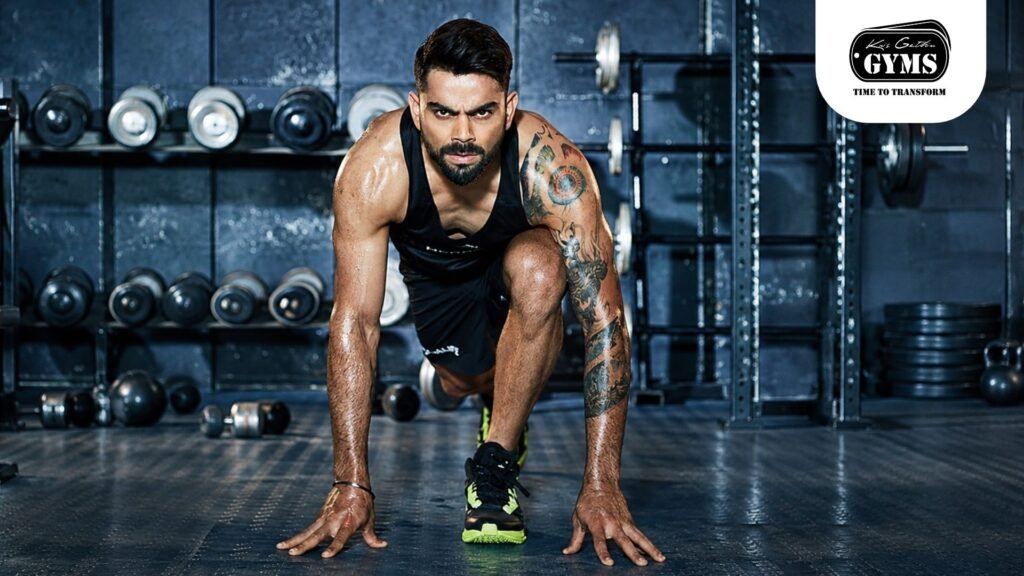
Virat Kohli is 36 years old, plays one of the most physically demanding sports on earth, and is still widely considered the fittest cricketer in the world.
His batting records are well documented. His transformation from a self-described snack-loving youngster into a peak-performance athlete is arguably the more remarkable achievement, and it didn’t happen by accident.
It happened through a deliberately engineered daily structure, repeated for years without exception. Here’s what that structure actually looks like, and what any working Indian adult can realistically take from it.
A Note On The Time Table
Kohli’s team has never published an official minute-by-minute schedule. What follows is reconstructed from his own public interviews, reporting by journalists who cover him closely, and the established principles of elite athlete training and recovery.
Treat the specific timings as evidence-based estimates built around his publicly known habits, not a confirmed personal schedule.
| Time | Activity |
|---|
| 4:45–5:00 AM | Wake up |
| 5:00–5:45 AM | Yoga and mobility session |
| 5:45–6:00 AM | Warm water with lemon, light hydration |
| 6:00–7:30 AM | Gym session, strength and conditioning |
| 7:30–8:15 AM | Post-workout recovery (stretching, cold shower) |
| 8:15–9:00 AM | Breakfast, high protein, clean carbs |
| 9:30–10:00 AM | Travel to ground / team meetings |
| 10:00 AM–1:00 PM | Cricket practice, batting and fielding drills |
| 1:00–2:00 PM | Lunch and rest |
| 2:00–3:30 PM | Rest / recovery protocol |
| 4:00–5:30 PM | Match preparation or evening fielding |
| 7:30–8:00 PM | Dinner, light and early |
| 9:00–9:30 PM | Wind-down, reading, no screens |
| 10:00–10:30 PM | Sleep, targeting 8 full hours |
On non-match days during IPL, the afternoon block typically shifts to extended gym work or skill drills. On match days, afternoon rest takes priority to preserve energy for evening performance.
The Turning Point: How This Discipline Actually Got Built
Kohli’s fitness journey wasn’t gradual. It was a conscious decision made at a specific point. After India’s 2012 tour of Australia, where he struggled both on and off the pitch, he made a complete lifestyle overhaul, replacing junk food, late nights, and a casual approach to conditioning with a performance-first philosophy.
The results showed up within a year. His running between wickets sharpened noticeably, and his ability to sustain energy over long innings improved considerably. What followed rippled across the Indian cricket team entirely, fitness standards that were once optional became mandatory under his captaincy.
The most important detail in this entire story: he wasn’t always fit. He built it, through deliberate habit change sustained over years. Fitness, in his case, was a system, not a genetic advantage.
The Gym Routine: Full Breakdown
Kohli follows a five-day training week with two active rest days. Total daily training time, including cricket skill work, can reach four to five hours on a full day, though his gym sessions specifically run 60 to 90 minutes, structured across four distinct phases.
Phase 1 : Yoga And Mobility
Every day starts with yoga, his most consistent and genuinely non-negotiable habit. He’s spoken publicly about starting a yoga practice around 2018, and it’s become foundational to how he manages his body well into his mid-thirties.
The benefits this provides specifically: genuine mobility and joint health supporting movements like diving, bending, and sprinting; meaningful cortisol reduction, critical for both focus and recovery; injury prevention through flexible connective tissue; and real mental clarity before a demanding training day.
Phase 2 : Gym Warm-Up
Five to ten minutes of light cardio, cycling or treadmill, followed by dynamic stretching, arm circles, leg swings, hip rotations, foam rolling through the quads, hamstrings, and thoracic spine, and glute and core activation before moving into heavier compound work.
Phase 3 : Strength Training
This is where Kohli’s approach is genuinely instructive for anyone training seriously. His strength work prioritizes compound movements first, isolation exercises second, the correct order for anyone training for athletic performance rather than pure aesthetics. The goal is lean, functional muscle, not maximum size.
His compound lifts include deadlifts (targeting the lower back, hamstrings, and glutes, supporting power transfer in his batting strokes), squats (quads, glutes, core, supporting running speed and explosive movement), lunges (legs, glutes, balance, supporting agility and directional change on the field), bench press (chest, shoulders, triceps, supporting upper body batting strength), pull-ups (back, biceps, core, supporting fielding strength and posture), overhead press (shoulders, core, supporting throwing power), and bent-over rows (back, biceps, counterbalancing the pressing movements).
Core and isolation work rounds this out, planks, Russian twists, and hanging leg raises for core, bicep curls, tricep extensions, and lateral raises for muscle balance, and calf raises supporting ankle and knee joint stability.
Most gym beginners actually do this in reverse, starting with isolation exercises and treating compound lifts as an afterthought. Kohli’s approach is the correct one: compound lifts build genuine athletic strength and burn more calories per set, while isolation work exists to correct imbalances afterward, not to lead the session.
Phase 4 : HIIT And Conditioning
This is what lets Kohli sprint for a quick single in the 40th over of a T20 with the same urgency he had in the first over.
His conditioning work includes sprint intervals (20 to 30 metre bursts with full recovery between sets), battle ropes (20 seconds maximum effort, 40 seconds rest, six to eight rounds), agility ladders (footwork patterns that transfer directly to fielding), box jumps (explosive power development), and cycling intervals as a lower-impact option during high-volume training blocks.
Phase 5 : Recovery
Kohli has credited recovery with the same seriousness as training itself, static stretching across all major muscle groups, cold showers (reportedly ice baths during intensive touring periods), specialist physio sessions during IPL and international tours, and eight hours of sleep treated as entirely non-negotiable.
How He Eats: The Short Version
Kohli’s food philosophy fits in a single line: food is fuel, not entertainment. He’s described being able to eat the same meals for months without getting bored, because he treats eating as a performance decision rather than a pleasure-driven one.
In 2018, he moved to a largely vegetarian diet on medical advice, following a cervical spine issue and high uric acid levels.
His current approach is built around plant proteins, whole grains, and clean cooking, and what’s been removed matters just as much as what’s been added, no fried food, no added sugar, no alcohol.
One detail worth carrying forward regardless of which parts of this routine someone tries to adapt: Kohli trains four to five hours daily, so his portion sizes are considerably larger than what an office worker actually needs. The composition of his meals is worth copying. The quantities aren’t.
Five Core Principles Behind The Results
Beyond the specific exercises and meals, Kohli operates on principles that explain his results considerably better than any single workout does, and these genuinely apply to anyone training seriously, not just elite athletes.
Consistency over intensity. Kohli trains whether in form or out of form, during IPL or the off-season. The discipline doesn’t switch on for tournaments and off during breaks, which is exactly why his fitness functions as a baseline rather than a peak he has to repeatedly climb back toward.
Training for performance, not appearance. His workouts are designed to make him faster, stronger, and more enduring on the field. The visible physique is a byproduct, never the actual goal, and that shift in objective changes how an entire program gets designed from the ground up.
Sleep as a genuine training variable. The eight-hour sleep target functions as a performance strategy, not a wellness suggestion. Growth hormone, which drives muscle repair and fat metabolism, is primarily released during deep sleep, meaning compromised sleep directly compromises the return on every single training session that came before it.
Hydration as non-negotiable. Kohli is known for consistent hydration throughout the day, particularly around training and match windows. Even mild dehydration, as little as 2% body water loss, measurably impairs strength, endurance, and cognitive function.
Mental fitness alongside physical. Kohli has increasingly spoken publicly about meditation, mindfulness, and managing the psychological demands of high-pressure cricket at the top level. He treats physical and mental fitness as genuinely connected systems, not separate tracks running independently.
The Gap Between Kohli And The Average Indian Adult
| Factor | Virat Kohli | Average Indian Adult |
|---|
| Daily training | 4–5 hours | 0–30 minutes |
| Weekly gym sessions | 5 days | 0–2 days |
| Protein per day | ~150–180g (estimate) | 40–60g |
| Sleep | 8 hours (strict) | 5–6 hours |
| Junk food | Eliminated | Several servings/day |
| Morning routine | 4:45 AM yoga + gym | Varied or none |
The gap is genuinely large, but every gap has a starting point. Improving any two of these variables consistently tends to produce visible results within 8 to 12 weeks, well before anyone would need to approach Kohli’s actual training volume.
A Realistic, Beginner-Friendly Version
Nobody should try to replicate a professional athlete’s full training load directly. Here’s a scaled version of the same underlying principles, built around a standard 9-to-6 working schedule.
A beginner’s daily structure : Wake at 6:00 AM. Five rounds of Surya Namaskar as a combined warm-up and yoga session from 6:15 to 6:30. A structured workout from 6:30 to 7:15 (see the weekly plan below). A cold shower and getting ready from 7:15 to 7:30. A high-protein breakfast by 8:00 AM. A balanced lunch, protein, complex carbs, vegetables, around 1:00 PM. A light snack, nuts or fruit, around 5:00 PM. A light, early dinner by 8:00 PM. Sleep by 10:00 to 10:30 PM.
A beginner four-day weekly split : Monday covers lower-body strength, squats, lunges, light-weight deadlifts, for 45 minutes. Wednesday combines cardio and core, cycling or jogging paired with planks and crunches, for 40 minutes. Friday covers upper-body strength, push-ups, dumbbell rows, shoulder press, for 45 minutes. Saturday runs a lighter HIIT session, short sprints and jumping jacks with rest intervals, for 30 minutes. Tuesday, Thursday, and Sunday stay as active rest, walking, Surya Namaskar, and stretching for 20 to 30 minutes.
Three immediate dietary shifts worth making : Replace one fried snack daily with a handful of mixed nuts or a boiled egg. Switch white rice to brown rice or millets for at least one meal daily. Add one serving of dal or paneer to each meal to hit roughly 20 to 25g of protein at both lunch and dinner.
Why This Discipline Matters Beyond Cricket
What makes Kohli’s routine genuinely instructive isn’t the specific exercise list, it’s the underlying structure. Compound movements before isolation work.
Recovery treated as seriously as training. Sleep protected as a performance variable, not sacrificed to a busy schedule. Consistency maintained whether motivation is high or low.
This is exactly the principle our coaches at KRIS GETHIN GYMS build programs around for every client, regardless of their starting point.
The specific loads and session lengths in an elite athlete’s program will always need scaling down, but the underlying discipline, train the fundamentals first, recover deliberately, stay consistent through the quiet stretches, translates directly into real results for anyone willing to apply it at a pace that actually fits their life.