There’s a specific moment in every partner workout, usually around the third missed ball pass, where someone starts laughing mid-squat and the whole set falls apart for a second.
That’s actually the point. Training with a friend changes what a gym session feels like entirely. The tougher reps get easier when someone’s counting them out loud for you, the awkward moments become the ones you actually remember, and finishing together beats finishing alone almost every time.
This session covers six exercises built specifically for two people, legs, upper body, and core all included, some testing genuine teamwork, others just asking you to find a shared rhythm.
What You’ll Need
A wall ball or medicine ball, a pair of dumbbells or kettlebells for each person, an exercise mat, enough clear space to move safely, and someone you actually want to spend the next thirty minutes sweating next to.
How This Workout Actually Works
Complete all six exercises in order to finish one round. Rest 30 to 60 seconds between exercises, and one to two minutes between full rounds. Two to three rounds total gets the job done.
Each person picks their own weight, there’s no requirement to match. Use a quick countdown to start each synchronized movement together, and split the responsibility, one of you counts reps out loud, the other keeps an eye on timing so neither of you falls out of rhythm halfway through.
The Six Exercises
1. Squat With Wall-Ball Pass (10 to 12 passes each)
Stand facing your partner, roughly two metres apart. One person holds a light wall ball at chest height.
Squat down together, chest lifted, knees tracking over the feet, and as you both stand, the ball gets thrown across with a chest pass. Your partner catches it at chest height, keeping it close to the body, then you both squat again before passing it back.
Keep alternating while staying genuinely in sync with each other’s timing.
2. Plank Ball Roll (30 to 40 seconds)
Face each other in a high plank, hands under shoulders, feet slightly wider than usual for balance, with a wall ball or medicine ball between you.
Keep the body in a straight line and the core braced throughout.
Lift one hand and roll the ball across the floor to your partner, who stops it and rolls it back.
Alternate hands, and keep the hips as still as possible, this one exposes any wobble instantly.
3. Synchronized Dumbbell Romanian Deadlifts (10 to 12 reps)
Stand side by side, feet hip-width apart, a dumbbell in each hand hanging in front of the thighs.
Bend the knees slightly, brace the core, and push the hips back together.
Lower the dumbbells close to the legs while keeping the back neutral, stopping the moment real hamstring tension shows up or the back starts to round. Drive the hips forward and stand tall together.
4. Synchronized Dumbbell Push Press (10 to 12 reps)
Side by side, feet hip-width apart, a dumbbell in each hand held at shoulder height. Brace the core, bend the knees slightly, chest lifted.
Drive through the feet and straighten the legs as the dumbbells press overhead together, finishing with arms fully extended and ribs pulled down rather than flared.
Lower under control back to the shoulders and repeat, staying synced with your partner throughout.
5. Synchronized Alternating Dumbbell Or Kettlebell Rows (10 to 12 reps per arm)
Side by side, feet hip-width apart, weight in each hand. Bend the knees slightly and push the hips back until the torso leans forward, back neutral, core engaged throughout.
Pull the right-hand weight toward the ribs, elbow tucked close to the body, lower under control, then row with the left arm. Keep alternating while the torso stays genuinely still, matching pace with your partner as you go.
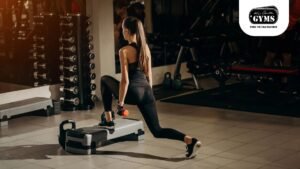
6. Synchronized Jumping Lunges (10 to 12 reps per leg)
Stand next to your partner in a split stance, lowering into a lunge with both knees bending, chest lifted, front knee tracking over the foot.
Push through both feet and jump straight up, switching legs mid-air, landing softly in a lunge with the opposite leg forward.
Keep alternating legs while staying synced, and control every landing before launching into the next jump.
Does This Work At Different Fitness Levels?
Yes, and staying in sync was never about matching weights or matching speed exactly.
Each person chooses their own load and, where needed, their own version of a movement.
One partner might do full jumping lunges while the other opts for reverse lunges instead, and you can still start and finish each set together without either of you compromising on genuine effort.
Different pairs approach this differently too. Some run identical exercises at separate weights side by side. Others share part of the session before splitting off into their own individual plans entirely.
What matters is finding the setup that actually works for both of you, not forcing a rigid match that leaves one person under-challenged and the other genuinely struggling.
Why This Kind Of Training Actually Sticks
One thing our coaches at KRIS GETHIN GYMS notice consistently: members who train with a genuine partner show up more reliably than members training entirely solo.
Accountability built into a friendship is considerably harder to skip than accountability built purely on personal willpower.
Nobody wants to be the one who cancels on their training partner, and that small social pressure, in the right context, turns into real consistency over months.
Bring a friend, choose your own weights, and don’t worry about perfect synchronization. Start together, support each other through the awkward moments, and build a session you both genuinely want to repeat.