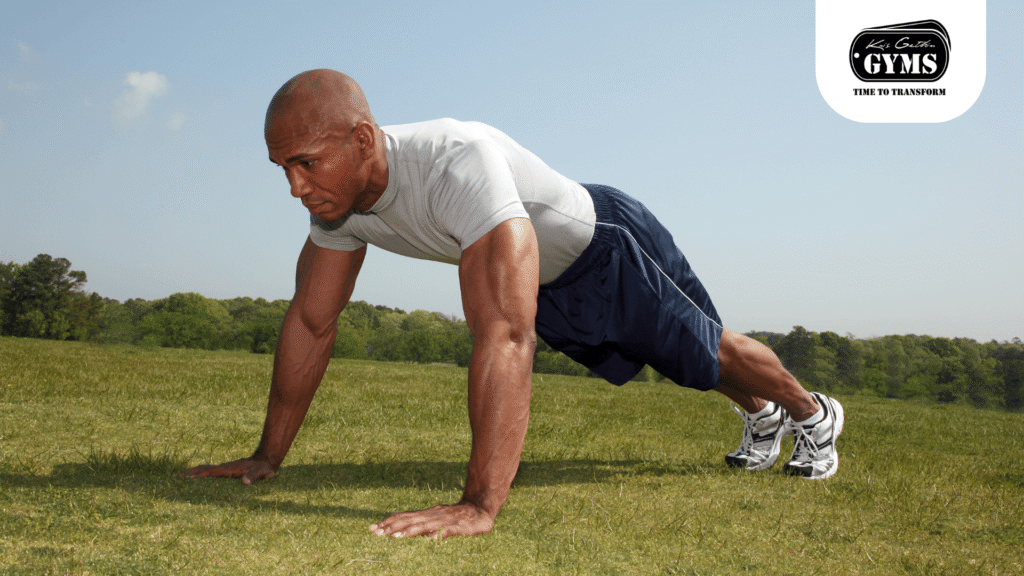
Watch someone bang out thirty push-ups without breaking a sweat, and you’d assume their chest is well built. Watch them closely, and you’ll usually see hips sagging, elbows flaring, and a chest that barely dips toward the floor.
That’s the push-up’s dirty secret. It’s mechanically simple enough that almost anyone can move through the motion, and demanding enough that almost nobody does it correctly without coaching.
No machine required, no gym membership, no excuse for skipping it, but genuinely hard to master. That combination is exactly why it’s stayed relevant through every fitness trend of the last century.
What’s Actually Working When You Do A Push-Up
Most people think of the push-up as a chest exercise. It’s more accurate to call it a moving plank with a press built into it.
The pectoralis major drives the actual pushing motion, assisted by the triceps extending the elbows and the front deltoids supporting at the shoulder. That much is expected.
What surprises most lifters is how much the exercise depends on muscles that aren’t pushing anything at all. The core and lower back keep the torso rigid throughout the movement, and the glutes actively prevent the hips from sagging.
Remove that stabilization, and the entire movement collapses into something closer to a lower-back strain than a chest exercise.
This is exactly why the push-up carries over so well into broader strength and athletic performance. It’s not isolating one muscle in a vacuum.
It’s teaching the entire body to hold tension under load, a skill that transfers directly into nearly every compound lift and athletic movement that follows.
The Technical Details That Actually Determine Whether It’s Working
If reps feel easy but the chest isn’t growing, form is almost always the problem, not the exercise itself.
Start with hand placement slightly wider than shoulder-width, actively screwing the palms into the floor as if rotating them outward without actually moving them. This single cue creates meaningfully better shoulder stability and chest engagement than a passive hand position ever will. The body should form a straight, unbroken line from head to heels, with glutes squeezed and core braced before the first inch of movement even begins.
The descent matters as much as the press. Lower under control across roughly two seconds, inhaling on the way down, with elbows traveling at a 30 to 45 degree angle from the body, an arrow shape, not a T.
Drop until the chest sits just above the floor, not halfway there. The press itself should be forceful and controlled, a strong exhale driving the body back up in about one second, maintaining full-body tension throughout rather than relaxing at the top of each rep.
The coaching cue worth remembering here: think “chest down, chest up,” not “head down, head up,” since fixating on head position alone tends to disconnect the rest of the body from proper form.
The Mistakes That Quietly Cap Every Set
A handful of errors show up repeatedly, and each one is fixable the moment it’s identified.
Hips sagging toward the floor, sometimes called the banana back, turns a chest exercise into a lower-back strain, and the fix is simple: tighten the glutes and core before every single rep, not just the first one.
Elbows flaring straight out into a T-shape overloads the shoulders and pulls tension away from the chest, corrected by keeping the elbows tucked into that arrow position throughout the movement.
Half reps, where the chest never approaches the floor, quietly rob a set of most of its actual value, better to reduce total reps and prioritize genuine depth than to rack up a higher number that isn’t doing real work.
And rushing the movement, relying on momentum rather than controlled strength, gets fixed by deliberately slowing the lowering phase and owning every inch of the descent rather than dropping and bouncing back up.
Progressing From First Rep To Advanced Variation
Push-ups scale remarkably well when progression is respected rather than skipped.
Beginners benefit from incline push-ups, hands elevated on a bench or box, reducing load while still teaching correct mechanics. Knee push-ups work as an acceptable alternative too, provided full-body tension stays intact rather than letting the hips trail behind.
The standard push-up serves as the real baseline worth mastering before chasing higher rep counts, clean, controlled reps here matter more than volume at this stage.
Once the standard version is genuinely solid, chest-focused variations open up meaningful new stimulus. Wide push-ups, hands placed wider than standard, increase chest emphasis while reducing tricep contribution.
Decline push-ups, feet elevated, shift more load toward the upper chest and shoulders. For advanced trainees, diamond push-ups, hands close together forming a diamond shape, become genuinely tricep-dominant and build real elbow lockout strength.
Deep push-ups, performed using push-up bars or plates to increase range of motion, deserve particular attention here, the deeper stretch placed on the chest at the bottom of each rep makes this variation especially effective for muscle growth specifically.
Strength, Stamina, Or Cardio: What’s Actually Being Trained
Push-ups are best understood as strength-endurance training, a category that doesn’t map neatly onto a simple strength-versus-cardio binary.
They build genuine strength because each rep involves pushing a significant percentage of bodyweight repeatedly. They build stamina because the chest, shoulders, and arms have to sustain repeated contraction over an entire set rather than a single maximal effort.
Performed in circuits, high-rep sets, or with minimal rest between sets, push-ups can absolutely elevate heart rate into genuinely cardiovascular territory, but that’s a secondary effect layered on top of the primary muscular adaptation, not the exercise’s core purpose.
How Many Reps Actually Matter
Chasing a fixed number, twenty, fifty, whatever sounds impressive, misses the more useful approach entirely. Reps in Reserve offers a smarter framework: perform each set until only one or two more clean reps could realistically be completed, stopping there rather than grinding out sloppy extras.
For most lifters, three to five sets, stopping at an RIR of one to two, with 60 to 90 seconds of rest between sets, provides a solid working structure.
This approach scales automatically as strength improves, since the RIR target stays consistent even as the achievable rep count within that target climbs over weeks and months.
Push-Ups Versus Bench Press : A Question With No Single Winner
Neither exercise is objectively better, they simply serve different purposes within a well-rounded chest program.
The bench press allows genuinely heavy loading, making it the stronger tool for building maximal strength and raw size over time.
Push-ups develop something the bench press can’t replicate as effectively, body control, joint health, and chest activation through a natural, unloaded range of motion that a barbell simply doesn’t demand in the same way.
The strongest chest training approaches use both deliberately, rather than treating one as a replacement for the other.
Building Push-Ups Into Sustainable Routine
Push-ups can be trained three to five times per week when volume is managed sensibly, since the movement doesn’t demand the same extended recovery window a heavy bench session might.
A brief warm-up matters more than most people assume, a minute of wrist circles and light shoulder mobility work prepares the joints for repeated loading, and since a push-up is essentially a dynamic plank, core readiness deserves attention too, not just the shoulders and chest.
If elbows or shoulders start feeling irritated during a training block, the right response is reducing volume, slowing tempo, and prioritizing recovery rather than pushing through discomfort that could develop into a genuine overuse issue.
Why Mastering This One Movement Matters More Than It Seems
One thing our coaches at KRIS GETHIN GYMS notice constantly : the lifters who eventually build serious pressing strength on a barbell are almost always the ones who took the push-up seriously first, not as a warm-up to rush through, but as a genuine strength movement worth coaching properly.
There’s no equipment excuse here, no gym membership required, no reason a push-up can’t be trained anywhere with the same intent as a heavy bench session. The barrier was never access. It was always whether the form got taken seriously enough to actually build something with it.
Test your clean max reps right now, honestly, full depth, no half reps counted. Then use this framework to add five genuine reps to that number by next week. Consistency beats complexity, in this movement and in nearly everything else worth building.