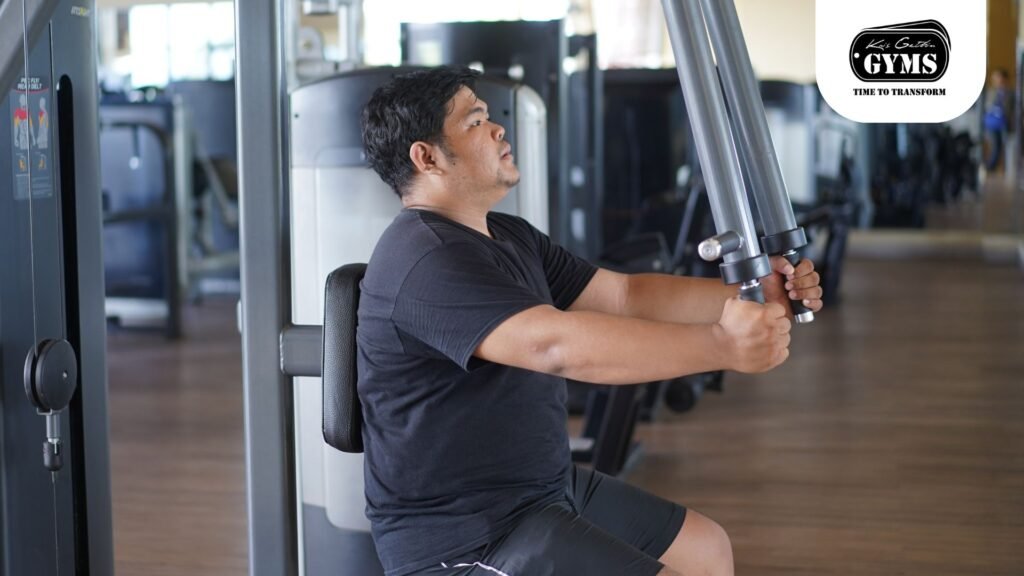
Stand in front of a row of chest press machines on a busy evening, and you will watch the same small scene repeat.
Someone walks up, glances at the seat angle, hesitates, and picks whichever one happens to be free.
That is understandable, because the three machines look almost identical from a distance.
The angle is the entire difference, and that angle decides which part of the chest gets most of the work.
Here is the short version before the detail: the seated chest press builds overall chest mass, the incline press emphasises the upper chest, and the decline press targets the lower chest.
For a complete, balanced chest, coaches suggest rotating through all three over time instead of living on just one.
Seated (Flat) Chest Press : The Foundation
The seated chest press uses a guided, linear path. The handles move straight out from the chest, and the machine controls the track, so your job is simply to push.
This angle works the whole pectoralis major, with the triceps assisting as secondary movers. It is the machine most people start on, and for good reason. It is the most reliable way to build overall chest strength and a base for everything else you do later, whether that is incline work, free weights, or pressing movements in sport.
Beginners get a lot from it because the fixed path reduces the technical burden. You can focus on feeling the chest do the work rather than worrying about balancing a bar.
Incline Chest Press : For The Upper Chest
The incline press pushes the movement upward and shifts more stress to the upper chest, specifically the clavicular head of the pecs. This is the area that gives the chest a fuller, firmer look near the collarbone.
It is also the area many lifters feel is lagging. If your chest looks flat on top no matter how many flat presses you grind through, adding incline work is usually the fix. Since the upper chest responds best to focused, hard sets, place the incline press early in your session while energy is high, instead of leaving it as an afterthought at the end.
Decline Chest Press : For The Lower Chest
The decline press drives the weight downward and places more emphasis on the lower chest. Fewer people use this angle than flat or incline, and plenty skip it entirely. That is a missed opportunity for anyone chasing a balanced look.
Flat and incline presses do not hit the lower chest in quite the same way. Skip the decline angle for long enough and you can end up with a strong upper and mid chest sitting above a lower chest that looks underdeveloped. A few sets of decline pressing give that region the direct attention it needs to keep pace.
Seated Vs Incline Vs Decline : Side By Side
| Feature | Seated (Flat) | Incline | Decline |
|---|
| Muscle emphasis | Overall chest (pec major) | Upper chest | Lower chest |
| Difficulty | Beginner-friendly | Beginner to intermediate | Intermediate |
| Best for | Overall mass and beginners | Fuller upper chest look | Complete lower chest development |
| Where it sits in a session | Early to middle | Early, while fresh | After the main pressing |
Chest Press Machine Vs Free-Weight Bench Press
Neither one replaces the other. They solve different problems.
| Factor | Chest Press Machine | Free-Weight Bench Press |
|---|
| Movement path | Fixed and guided | Free, you control the bar |
| Stabiliser demand | Lower | Higher |
| Chest isolation | Easier to achieve | Shared with stabilisers |
| Injury risk for newer lifters | Lower | Higher without good technique |
| Best suited to | Beginners, consistent lower-risk training | Advanced lifters building stability and carryover |
The machine guides your motion, which makes it easier to isolate the chest and keep form consistent. That suits beginners and anyone returning to training who wants to minimise injury risk. The bench press asks your stabiliser muscles to control the bar’s balance, which builds functional strength that carries into other lifts, and that is why more experienced lifters lean on it.
So the choice depends on your goal. For steady, lower-risk work, the machine is excellent. For stability and transferable strength, the bench press earns its place. Most well-built programmes use both. And a seated chest press is genuinely effective for building chest mass, even though the bench press recruits more stabilisers.
How To Order The Angles In A Session
A practical rule: train your weakest angle first, while you are freshest, then move on to the others. For many lifters that means incline first, because the upper chest is the usual laggard. If your lower chest is the weak point, lead with decline.
Across a training week, you do not need all three in every session. Rotating them across sessions, or leading with a different angle every few weeks, covers the whole chest without overloading the shoulders.
As with any lift, the principle that makes it work is progressive overload. Log your weight and reps, and aim to beat them next time.
What To Look For When Buying A Chest Press Machine (For Gym Owners)
If you are fitting out a facility, a few criteria matter more than anything else on the spec sheet:
- Adjustable seat and pad angles, so members of every shape and size can set up comfortably
- Weight stack capacity with enough range for beginners and strong lifters alike
- Durability, because commercial machines take heavy daily use and need to last
- Space efficiency, so the machine does not crowd the floor or block movement
On the question of how many machines a gym needs, at least two of the three angles is a sound minimum, since it covers the majority of member requests and adds real value to the floor.
Members notice when a facility has thought about its equipment mix, and the chest area is one of the first places they look.
This is the same logic we apply when planning floors across the KRIS GETHIN GYMS network, where the equipment mix is built around how members actually train.
Putting It All Together
The three machines are not rivals. Each one trains a different part of the same muscle, and a chest built from all three angles looks and performs better than one built from a single favourite.
Start with the seated press to learn the pattern, add incline work if the upper chest lags, and bring in the decline press for balance. Keep tracking your numbers and keep pushing them up.