If there’s one muscle group that quietly controls how strong, balanced, and injury-free you stay in the gym, it’s your shoulders.
I’ve seen people push heavy chest days and brutal back workouts, but the moment their shoulders lag behind, everything starts falling apart. Pressing strength plateaus.
Posture gets worse. And those small, nagging injuries? They usually start here.
So instead of just throwing random exercises into your routine, let’s break this down the way it actually works in real training – simple, practical, and effective.
Understanding Your Shoulders
Your shoulder isn’t just one muscle – it’s a system.
- Front delts (anterior) : Used in pressing movements
- Side delts (lateral) : Give your shoulders width
- Rear delts (posterior) : Support posture and pulling strength
- Rotator cuff : Keeps everything stable and injury-free
Most people unknowingly overtrain the front delts and ignore the rear. That’s exactly why shoulders start feeling tight, weak, or painful over time.
The Core Principle Most People Miss
It’s not about doing more exercises.
It’s about training all three heads properly and consistently.
If your program is only pressed and raised in front of the mirror, you’re leaving results on the table.
The Most Effective Dumbbell Shoulder Exercises
These are the ones that actually deliver results – not just pumps.
1. Seated Dumbbell Shoulder Press
This is your foundation movement.
You remove momentum and force your shoulders to do real work. Over time, this builds both size and strength.
How to think about it : Control the weight. Don’t rush reps. If your lower back starts arching, you’re going too heavy.
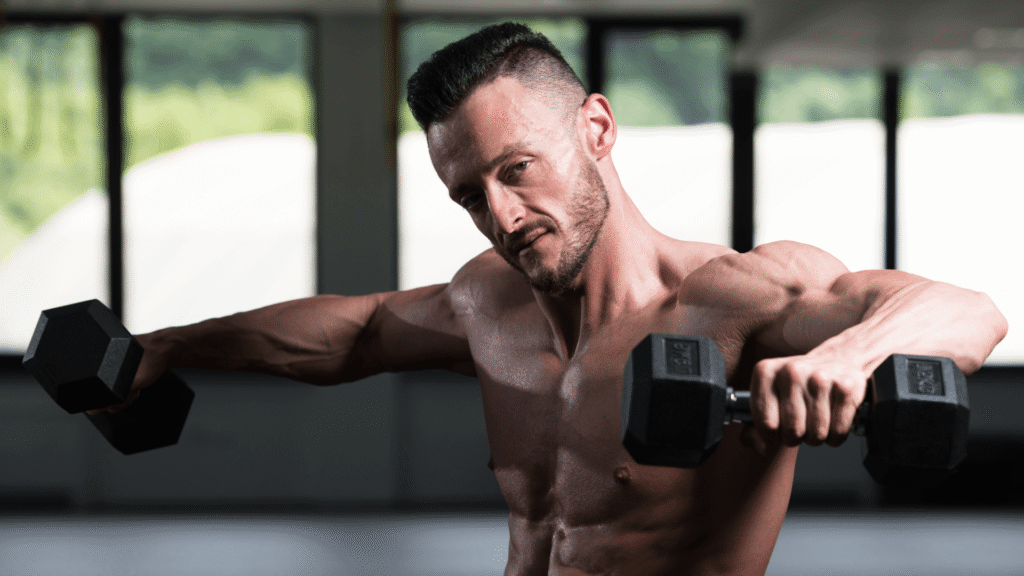
2. Dumbbell Lateral Raise
If you want broader shoulders, this is non-negotiable.
Most people do this wrong by swinging heavy weights. That kills the purpose.
What works better : Lighter weight + strict control = better side delt activation.
3. Dumbbell Front Raise
Simple, but effective when used correctly.
You don’t need to go heavy here because your front delts are already active in pressing exercises.
Tip : Slow down the lowering phase. That’s where the real work happens.
4. Dumbbell Reverse Fly
This is where most people fall short.
Rear delts are usually weak because they’re ignored. Fixing that instantly improves posture and pulling strength.
Execution matters : Focus on squeezing your shoulder blades – not just lifting the weight.
5. Dumbbell Arnold Press
Popularized by Arnold Schwarzenegger, this variation adds rotation to the press.
That rotation increases muscle activation across multiple heads.
Reality check : You’ll need to go lighter than your regular press – and that’s okay.
6. Upright Rows (Dumbbell Version)
Great for combining shoulder and trap work.
Important : Don’t pull too high. That’s where shoulder irritation begins.
7. Plank Shoulder Raise
This one’s underrated.
It builds stability + core + shoulder control in one movement.
If your shoulders shake during this, that’s a good sign – you’re working stabilizers properly.
Gym-Based Shoulder Exercises That Actually Add Value
If you train at a gym, these will take your progress further.
Barbell Overhead Press
The king of shoulder strength.
This isn’t just a shoulder movement – it’s a full-body effort.
If you want raw power, this is it.
Machine Shoulder Press
Perfect for controlled hypertrophy.
You don’t worry about balance – you just focus on pushing intensity.
Cable Face Pull
Honestly, this is one of the best exercises you can add.
It fixes posture, strengthens rear delts, and protects your shoulders long-term.
If you skip this, you’re making a mistake.
Cable Lateral Raise
Cables keep constant tension – something dumbbells don’t provide.
That constant tension is what improves muscle definition over time.
Warm-Up : The Step Most People Ignore
I’ve seen this too often – people jump straight into heavy presses.
Then they wonder why their shoulders hurt after a few weeks.
A proper warm-up takes 5–10 minutes :
- Arm circles (start small, go bigger)
- Resistance band pull-aparts
- External rotations
- Light lateral raises
That’s it.
But this small step can save you months of pain.
What a Balanced Shoulder Workout Looks Like
You don’t need 10 exercises.
A simple, effective session :
- Shoulder Press (heavy)
- Lateral Raise (strict)
- Reverse Fly (controlled)
- Face Pull (high reps)
That covers strength, width, and stability.
The Real Secret to Strong Shoulders
It’s not intensity alone. It’s not just volume either.
It’s balance + consistency + control.
Train all heads. Respect your joints. Progress gradually.
Do that, and your shoulders won’t just look better – they’ll actually perform better in every lift you do.
Final Thought
Strong shoulders change everything.
Better posture. Stronger lifts. Lower injury risk.
But only if you train them right.
If your current routine feels random or unstructured, fix that first. Because once your shoulders are built properly, everything else in your training starts improving automatically.