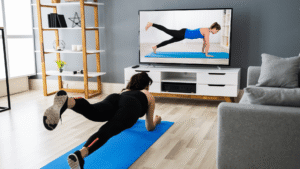
If you ask anybody why they want to work out at home, you’ll get the same answer every time.
“No travel. No waiting. No excuses.”
It sounds perfect.
But the reality? Very different.
I’ve trained people inside commercial gyms for more than a decade, and I’ve also trained folks who wanted to exercise at home, in their bedrooms, balconies, terraces, hallways – wherever they found space.
And after all these years, I’ve noticed something people don’t like to say out loud:
Working out at home feels good for the first few days… and then something shifts.
Most quit – Not because home workouts are bad, but because the challenges are far bigger than YouTube videos make them look.
Let me walk you through what I’ve actually seen – not theories, not copy-paste advice, but what happens in real Indian homes.
1. Motivation Doesn’t Survive in the Same Room You Relax In
Whenever someone tells me, “Rahul, I’ll train at home, I don’t need the gym,” I ask them a simple question :
“What room are you training in?”
Almost 9 out of 10 say:
“My bedroom.”
Trust me, I’ve attempted this myself.
Try holding a plank next to the same bed where you sleep.
Your brain whispers, “Why am I doing this?”
You push. And two days later the mat stays folded.
At the gym, your brain shifts into athlete mode. At home, it stays in comfort mode.
Environment is more powerful than motivation, and very few people realise this until the enthusiasm dies.
2. Equipment Limits Your Growth, No Matter How Positive You Stay
I remember one client, Priya.
She sent me a text saying she’d do full body workouts at home with no weights.
Great start. Three months later she said : “Rahul, I feel fitter, but I don’t look stronger. Why?”
Bodyweight training does work beautifully… until it stops working.
To keep gaining muscle or strength, you need : heavier weight, more tension, progression.
Push-ups alone can’t take you far.
Most homes don’t have : dumbbells, barbells, cable machines, or even a pull-up bar.
Not because people don’t want them, but because houses are not built to support this stuff.
Progress stalls, and people slowly lose interest.
3. Distractions Will Eat You Alive
People don’t talk about this enough.
Home isn’t a gym.
Home is : doorbells, WhatsApp pings, kids asking questions, neighbours shouting, dogs barking, pressure cooker whistles, phone calls, tea breaks
I’ve seen people pause workouts after every set to reply to a notification.
Gym = tunnel vision.
Home = chaos.
Even the most dedicated person breaks down under constant interruption.
4. At Home, Nobody Is Watching You… and That Sounds Good Until It Isn’t
In gyms, there are tiny little accountability systems you don’t notice : someone nods at you when you lift well you spot familiar faces people expect to see you.
It doesn’t feel like pressure, but it is.
And weirdly, it’s helpful.
At home, when you skip 10 days straight, nothing happens.
Nobody knows. Nobody cares.
And that emotional silence kills momentum.
5. Technique Doesn’t Improve Without Feedback
This is a painful one.
I’ve corrected people’s push-ups hundreds of times. Most were trained at home through YouTube content.
Everyone thought they were doing it correctly.
They weren’t.
Home workouts remove mirrors. Remove trainers. Remove adjustments.
Bad form doesn’t just slow progress – it causes shoulder pain, knee aches, lower back stress.
Once pain enters the picture, motivation exits.
6. You Plan a Workout… But End Up Browsing Workouts
Here’s what usually happens :
You search for “15 minute home fat burning workout.”
You watch one video.
Then another.
And another.
By the time you choose a routine, you’re tired from scrolling – not training.
Gyms simplify exercise : The equipment decides half the movement.
Home workouts require planning, and planning drains mental energy.
Beginners underestimate that.
7. Space Is Not Enough, You Need Atmosphere
Many Indian houses don’t have carpet or gym flooring.
Tile floors hurt knees. Ceiling fans hit skipping ropes. Furniture crowds movement. Neighbours complain about noise.
I had someone message me saying, “Rahul, my parents don’t like me jumping because the cups in the kitchen vibrate.”
These are real obstacles. No motivational reel talks about them.
8. Consistency Is Hard When Life Shares the Same Room
At home, life merges with workout time.
You finish one set. Mother asks for help. Back to workout. Doorbell rings. Back to workout. Boss sends message.
Your nervous system never settles.
Training becomes stop-start chaos, not a focused process.
9. Loneliness Breaks Progress Emotionally
People underestimate the power of humans around them.
When you train in a gym, you don’t realise how much other people help you : someone grunting heavy squats. someone running hard on a treadmill, someone bigger or stronger passing by..
That energy lifts you subconsciously. Home offers none of that.
You are alone with effort.
And loneliness drains enthusiasm a little everyday.
10. The Mental Load Is Higher Than the Physical One
At home, YOU must decide everything : what to train, how long, what reps, what exercises, what progression, what warm-up
In the gym, structure exists around you.
That mental load is why home workouts die early.
Not because they are bad, but because they require a mindset most people never trained for.
So, Can Home Workouts Work?
Of course they can.
I’ve seen people build amazing strength, lose fat, feel lighter, improve mobility – all inside their living rooms.
But that only happens if you treat home training like real training, not like temporary activity.
You need rituals : same time, same location, same routine, phone away, written plan, progressive overload, upgraded resistance, community support (even online helps)
Otherwise, the environment will swallow your intentions.