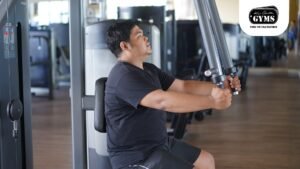
Look at a lifter’s chest from the side and you can tell within a second whether he trains the upper portion.
A well-built upper chest fills the space under the collarbone and gives the torso a square, lifted shape. A neglected one makes even a strong chest look like it’s sliding downward.
Plenty of lifters bench for years, add plates, and wonder why the top of the chest never catches up.
Flat pressing alone rarely gets it done. The clavicular head of the pec, the fibres running toward your collarbone, needs its own angles and its own sets.
Why The Upper Chest Falls Behind
Flat benching leans on the middle and lower fibres. The upper fibres work hardest when your arms travel upward and inward, which is what an incline does.
The evidence backs this up. A 2010 study of 15 men found the clavicular head showed greater activation at incline angles of 44 and 56 degrees, while the lower fibres worked harder on a flat bench. Research on cable work adds to the picture.
A 2022 study by Schütz and colleagues found cable pulley exercises produce larger shoulder joint moments than bench pressing, which means more stretch at the bottom and a harder squeeze at the top.
The practical takeaway is simple. Choose a moderate incline, vary your tools, and train the upper chest early in the session, while your nervous system is fresh.
Incline Dumbbell Press : The Starting Point
If you only add one movement, make it this one. Dumbbells give a longer range of motion, let your wrists and elbows move naturally, and make each arm work on its own, which helps even out left and right differences.
Set the bench between 30 and 45 degrees. The lower end is the smart choice for most people, because a steep angle hands the tension to your front delts. Kick the dumbbells up, stack wrists over elbows over shoulders, pull your shoulder blades together, and lower with control until your elbows sit at or just below chest level, roughly 45 degrees from your torso. Press in a slight arc so the dumbbells finish above your collarbone, and stop short of clanging them together.
Prescription : 4 sets of 8 to 10 reps, 1 to 2 reps left in the tank, a 3-second lowering phase, and 90 to 120 seconds of rest.
Incline Barbell Or Smith Machine Press : For Heavy Loading
Dumbbells build control. The barbell builds raw numbers. Dumbbells can’t match the absolute loads you can move with a bar, so an incline barbell or Smith machine press earns a place when strength is the target.
Keep your shoulder blades retracted and bring the bar down toward your upper sternum, not your neck. The Smith machine is a useful option for lifters training alone or working near failure, since the fixed path lets you focus on pushing.
Prescription: 3 to 4 sets of 6 to 8 reps, with 2 minutes of rest. This is where you chase progressive overload with the heaviest loads of your upper chest work.
Reverse-Grip Bench Press : The Underused Option
Holding the bar with an underhand grip sounds odd, and it works. A study in the Journal of Strength and Conditioning Research found reverse-grip benching increased activity in the clavicular pec and the biceps. The tucked elbow position also tends to feel kinder on the shoulders.
It’s a strong choice if your gym is short on incline benches. Take a grip just wider than shoulder width, retract your shoulder blades, unrack with a spotter, and lower toward the lower chest while keeping the elbows close to the body.
Prescription : 3 sets of 8 to 10 reps, 90 seconds of rest. Start lighter than you expect and build up.
Cable Fly And Squeeze Press : Isolation For Shape
Once the heavy pressing is done, shift to movements that keep tension on the muscle through the whole arc.
Low-to-high cable fly : Set the pulleys low, step into a staggered stance, and sweep the handles upward and inward until your hands meet around chest height. Keep a slight bend in the elbows and don’t shrug. Cables hold tension from stretch to squeeze in a way dumbbells can’t.
Incline dumbbell squeeze press : Press two dumbbells together from start to finish, palms facing each other, on a 30 to 45 degree bench. The constant squeeze is a direct lesson in mind-muscle connection, and you’ll feel it near your collarbone very quickly.
Prescription : Cable fly, 3 sets of 12 to 15 reps with 60 seconds of rest. Squeeze press, 2 to 3 sets of 10 to 12 reps with similar rest.
Landmine Press And Decline Push-Ups : Shoulder-Friendly And Home Options
The landmine press moves along an upward diagonal that lines up well with the clavicular fibres. The fixed arc is also easier on the shoulder joint than a strict overhead press, so it suits lifters with a history of shoulder trouble. Press one arm at a time from a half-kneeling or standing position, keeping your core braced and your elbow tucked.
Decline push-ups need nothing but a bench, box, or sturdy sofa. Raising your feet shifts more load onto the chest and front shoulders, mimicking an incline press. They’re harder than they look. To scale down, lower the platform or put your knees on it. To scale up, rest a plate on your back or loop a band across it. Use them as a finisher or as your main upper chest movement on a home day.
Putting It Together : A Sample Upper Chest Session
Place these early in your chest day :
| Exercise | Sets x Reps | Rest |
|---|
| 30-degree incline dumbbell press | 4 x 8-10 | 90-120 sec |
| Incline barbell or Smith press | 3 x 6-8 | 2 min |
| Low-to-high cable fly | 3 x 12-15 | 60 sec |
| Decline push-ups (finisher) | 2 x to near failure | 60 sec |
Rotate in the reverse-grip bench, squeeze press, or landmine press every few weeks so the angles stay fresh. Use double progression: add reps until you hit the top of the range on every set, then add weight.
Recovery And Food Decide The Result
Sets only count if you recover from them. Aim for 7 to 8 hours of sleep and around 1.6 to 2.2 grams of protein per kilogram of body weight daily.
For most Indian lifters that means building meals around paneer, soya chunks, eggs, chicken, dal, and curd, with a clean whey isolate to fill gaps.
A balanced chest also protects your shoulders. Strong upper pec fibres help stabilise pressing at an upward angle, and fixing muscle imbalances lowers the odds of the shoulder strain that sidelines so many lifters.
Add a little patience, and the top of the chest starts to catch up within a few months.