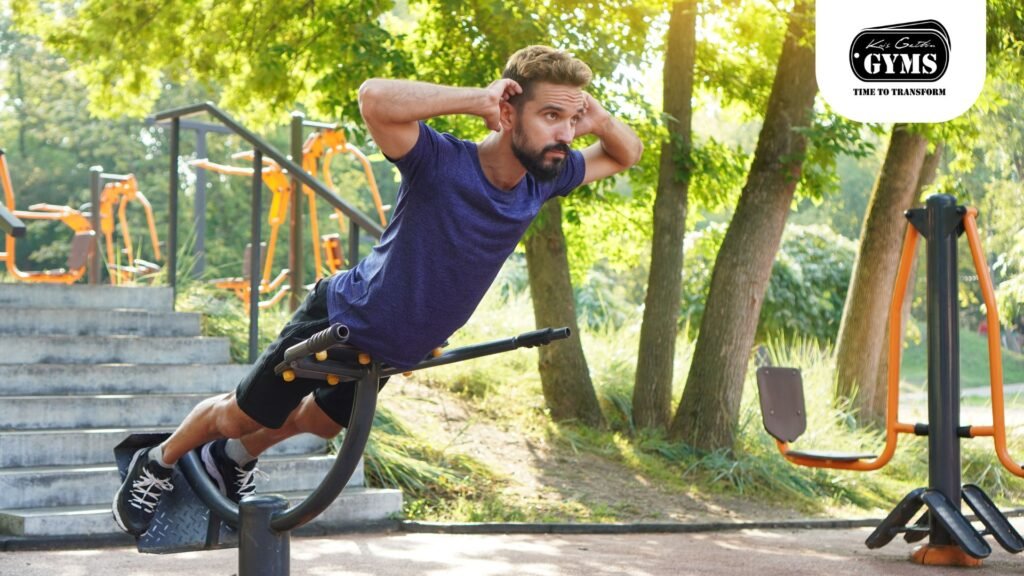
Watch someone new to the hyperextension bench, and the instinct is almost always the same. Lower down, then throw the chest up as high as possible, treating a bigger arch like a badge of effort.
That instinct is exactly backwards, and it’s precisely why this exercise gets a reputation as a lower-back movement when, done correctly, it’s genuinely a posterior chain builder training the glutes and hamstrings just as much as the spinal erectors.
The name itself doesn’t help. “Hyperextension” sounds like it demands pushing the spine well past neutral. It doesn’t.
A well-executed rep finishes when the shoulders, hips, and ankles form a clean, straight line, nothing more dramatic than that.
What The Hyperextension Actually Is
This is a supported hip-hinge movement performed on a 45-degree or horizontal back extension bench, sometimes called a Roman chair.
With the lower body secured against the pads, the torso lowers toward the floor by hinging at the hips, then the glutes, hamstrings, and back extensors work together to return the body to alignment.
It’s commonly used as an accessory movement rather than a primary lift, complementing compound exercises like the barbell squat or deadlift by adding focused posterior chain work without demanding another heavy barbell session.
In most gyms, “hyperextension” and “back extension” get used interchangeably, though back extension is arguably the more technically accurate name, since a well-controlled rep finishes at neutral rather than forcing the lumbar spine into an exaggerated arch.
Worth clarifying upfront, this has nothing to do with a joint hyperextension injury, where a knee or elbow gets forced beyond its normal range. This is a deliberate, controlled strength movement performed on purpose-built equipment.
The Muscles Genuinely Doing The Work
This exercise trains several muscle groups together, and exactly which ones dominate depends on setup choices, bench angle, pad height, knee position, and how much spinal movement gets allowed during the rep.
- The erector spinae, the long muscles running along both sides of the spine, extend the trunk and resist unwanted spinal flexion as the upper body moves against gravity. During a genuinely hip-dominant hyperextension, they primarily maintain a stable torso while the glutes and hamstrings do the actual work of extending the hips. Developing these muscles supports the torso control needed during squats, deadlifts, and other loaded hinges, but that development doesn’t require repeatedly forcing the lumbar spine into an extreme arch. Controlled loading within an appropriate range matters more than chasing maximum extension.
- The gluteus maximus, one of the primary hip extensors, contributes directly as the torso rises and the hips return to alignment. Glute involvement increases meaningfully when the movement is performed as a genuine hip hinge rather than a spinal movement, positioning the thigh pad below the hip crease, letting the hips move freely, keeping the torso controlled, and actively driving the hips into the pad on the way up. Research on gluteus maximus activation confirms several hip-extension exercises produce meaningful engagement here, though activation alone doesn’t guarantee muscle growth on its own, progressive resistance, volume, nutrition, and recovery all still matter.
- The hamstrings assist the glutes in extending the hips while helping control the lowering phase. Their contribution shifts with knee position, relatively straight knees lengthen the hamstrings under stretch, while slight knee flexion reduces that stretch and can feel more comfortable for some lifters. Locking the knees aggressively isn’t necessary, a stable position that allows a smooth hinge without discomfort works better.
- Supporting muscles, the adductor magnus, abdominals, obliques, smaller spinal stabilizers, and upper-back muscles, all contribute to overall stability. The adductor magnus assists with hip extension directly, while the abdominals and obliques help control pelvic and trunk position throughout the movement.
Setting Up And Executing The Movement Correctly
- Adjust the thigh pad first. Position its upper edge slightly below the hip crease, supporting the upper thighs without pressing heavily into the abdomen. Hips need to hinge freely over the pad, a pad sitting too high blocks hip movement and encourages compensation through the lower back instead.
- Secure the feet and lower legs. Feet planted firmly against the platform, ankles or lower legs positioned beneath the rollers, checked for even placement, secure hold, and no forward sliding.
- Establish the starting position. Body aligned head to heels, arms crossed over the chest, abdomen gently braced, shoulders relaxed, head following the torso’s natural line rather than lifting the chin sharply upward.
- Lower under control. Push the hips back and hinge forward over the pad, lowering only as far as genuine control allows, mobility, limb proportions, and machine design all shape available range. More range isn’t automatically better, and forcing a predetermined depth defeats the point entirely.
- Extend through the hips. Contract the glutes and hamstrings to initiate the upward phase, raising the torso smoothly while maintaining abdominal tension. Think “extend the hips,” not “throw the chest up.”
- Finish in a straight line. Stop the moment shoulders, hips, and ankles align. Continuing to lift until the lower back arches heavily isn’t necessary and adds risk without adding benefit.
A reasonable beginner tempo runs roughly two to three seconds on the way down, a brief controlled transition at the bottom, one to two seconds coming up, and a short pause at the top before the next rep.
The Mistakes That Undermine This Exercise
- Extending too far at the top shifts the movement away from controlled hip extension and pushes more motion into the lumbar spine. The fix is simple, stop when the torso and legs align, finishing through a glute contraction rather than throwing the chest upward.
- Positioning the pad too high presses into the abdomen and blocks the hip crease, restricting hip movement and often causing compensation through the lower back. Lower the pad so it supports the thighs while letting the hips hinge freely.
- Using momentum, letting the torso drop quickly and swing back up, reduces muscular control and makes the finishing position harder to manage. Slowing the lowering phase and pausing briefly before the ascent fixes this directly.
- Lifting the head first, throwing it backward before the torso rises, disrupts the head-to-torso relationship and can encourage unnecessary spinal extension. Keeping the head aligned with the torso, letting the gaze move naturally, avoids this.
- Adding weight too soon, before bodyweight reps are genuinely consistent, magnifies existing setup and technique errors rather than building real strength. Master smooth bodyweight repetitions first.
- Chasing maximum depth turns range of motion into the priority over movement quality. Use the deepest range that stays controlled, pain-free, and free of bouncing, nothing more.
Targeting Glutes Versus Lower Back Specifically
Hyperextensions always engage multiple muscle groups simultaneously, but technique adjustments genuinely shift relative emphasis.
- For greater glute and hamstring emphasis, use a hip-dominant technique, pad below the hip crease, descent initiated through the hips, controlled trunk position, hips actively driven into the pad on the ascent, glutes contracted hard near the top, finishing at neutral. This should feel like a supported hip hinge, not a repeated lower-back arch.
- For greater erector spinae demand, allowing more movement through the trunk increases dynamic demand on the spinal extensors specifically. This approach genuinely requires more technical control and more conservative loading, and beginners should master the stable hip-hinge version first before experimenting with additional spinal movement.
Why This Exercise Earns A Place In A Serious Program
It strengthens the posterior chain as a unit, training glutes, hamstrings, and spinal extensors together, muscles that contribute directly to hip extension, trunk stability, and a wide range of common lifting movements.
It builds genuine back-extensor strength. Research on structured back-extension training has reported real improvements in back-muscle strength and spinal range of motion. That said, this supports its use as a progressive strength exercise, it doesn’t mean the movement cures back pain or prevents every type of spinal injury on its own.
It improves hip-hinge control directly relevant to Romanian deadlifts, good mornings, kettlebell swings, and conventional deadlifts, teaching the body to move through the hips while keeping the torso genuinely controlled.
It complements squats and deadlifts as accessory work, providing additional posterior-chain training without requiring another heavy barbell session, positioned as a supplement to a balanced program rather than a replacement for the major lifts.
It offers real progression without immediately adding heavy weight, extending the arms forward, holding a plate or dumbbell, adding a resistance band, slowing the tempo, pausing at the top, or increasing reps all add difficulty before load becomes necessary.
It requires less setup than heavy barbell hinges, once adjusted, the bench provides a stable, repeatable position for focused posterior-chain work without lifting a loaded barbell from the floor.
45-Degree Versus Horizontal Bench
Both bench styles train the same general muscle groups, but body angle changes how the resistance actually feels.
| Feature | 45-Degree Bench | Horizontal/90-Degree Bench |
|---|
| Body position | Diagonal | Horizontal |
| Bodyweight challenge | More manageable | More demanding |
| Beginner suitability | Generally better | Often better for experienced lifters |
| Training feel | More supported | Longer resistance lever |
Equipment naming isn’t always consistent across manufacturers, so evaluating the actual design matters more than trusting a product name alone.
Programming Hyperextensions
| Goal | Sets | Reps | Resistance |
|---|
| Technique practice | 2 – 3 | 8 – 12 | Bodyweight |
| General strength and endurance | 2 – 4 | 10 – 15 | Bodyweight or light |
| Muscle-building accessory work | 3 – 4 | 8 – 15 | Controlled external load |
| Warm-up or activation | 1 – 2 | 10 – 15 | Easy bodyweight |
Hyperextensions typically fit well after squats, deadlifts, or Romanian deadlifts, or near the end of a lower-body session. Avoid heavily fatiguing the spinal extensors before demanding compound lifts unless that sequencing serves a specific training purpose.
Training Safely
Hyperextensions suit many healthy trainees when performed with appropriate equipment, controlled resistance, and a sensible range of motion, but no exercise fits everyone.
Stop and seek professional guidance for sharp or worsening lower-back pain, pain radiating into the hip or leg, numbness or tingling, new weakness, or loss of movement control.
Anyone with a diagnosed spinal condition or recent injury should consult a qualified healthcare professional before loading this movement.
This is exactly the standard our coaches at KRIS GETHIN GYMS apply to posterior-chain training generally, controlled hip-hinge mechanics first, load added only once the pattern is genuinely consistent, treating range of motion and technique as the actual measure of progress rather than how dramatic the movement looks.