People think stretching is a warm-up ritual you do for five seconds before lifting weights or running, almost like a checkbox.
Touch your toes, twist left and right, hold one hamstring stretch for a heartbeat – done.
Then weeks later, they complain about tight lower backs, stiff knees, shoulder strains, and wonder why their workouts feel harder than they should.
I have seen it repeatedly. The strongest guys in the gym walk awkwardly because their hips are locked. Women training glutes can’t activate properly because their quads and hip flexors are like piano wires.
And beginners? They often get injured not because the exercise was too heavy, but because the muscle couldn’t move through the range it needed.
Stretching isn’t decoration. It’s not optional. It’s the base layer that supports strength, movement, and prevention.
Why Stretching Matters More Than Most People Think
Your muscles shorten throughout the day. Sitting does it faster than training does.
Think about how your body spends most hours : desk, phone, driving, eating, couch, bed.
Nearly everything involves bending forward and barely ever extending.
Over time, your body adapts to what you repeat. So that tightness you feel isn’t random – it’s your muscles trying to survive your lifestyle.
When you stretch regularly, especially the hips, shoulders, and hamstrings, you’re giving your body space to move again. Suddenly squats feel smoother. Running feels lighter. You breathe deeper. You recover faster.
That’s the real benefit – movement without pain.
Stretching Helps Prevent Injuries
The number one reason injuries happen in the gym is simple : the range of motion demanded by an exercise doesn’t match the range the muscle can actually perform.
Picture trying to squat deep when your calf muscles and hamstrings are locked tight. You’ll compensate through the lower back. Over time, you’ll pay for it.
Stretching increases muscle length and tolerance. It teaches the joints how far they’re supposed to travel safely. And when a joint can move freely, strength training becomes safer and more productive.
I’ve trained people who struggled to lift an empty barbell safely – tight shoulders, stiff thoracic spine, hips that barely moved.
Three weeks of consistent stretching transformed their lifts more than any coaching cue ever did.
Improved Flexibility Means Better Posture and Better Training Results
Flexibility isn’t only about touching the floor.
It’s about how your body feels when you wake up in the morning.
It’s about the way you stand, the way you move, and the way your muscles fire.
Women who stretch their hips and hamstrings often notice their lower back pain fading.
Men who stretch their pecs and shoulders suddenly stand straighter because their chest isn’t pulling them forward anymore.
Even everyday things :
- walking upstairs
- bending to pick up bags
- sitting cross-legged
become easier.
Flexibility makes your body efficient rather than resistant.
Stretching Enhances Recovery
When you train, muscles tighten. That’s normal.
What isn’t normal is letting that tightness sit for days.
Stretching moves blood into the muscle, and blood carries oxygen and nutrients. Better blood flow means better healing.
Ask anyone who lifts seriously – on days they stretch before bed, they wake up feeling less sore the next morning.
It’s not magic. It’s biology.
Mental Benefits People Ignore
Stretching slows you down.
Three minutes of deep breathing while holding a stretch can calm your nervous system more effectively than scrolling your phone ever will.
Many people stretch at night because it relaxes their muscles and their mind.
That keeps cortisol down, which indirectly supports recovery, fat loss, and sleep.
There’s a reason yoga has survived thousands of years.
Stillness is a tool.
How Much Stretching Do You Really Need?
Not an hour a day.
Not complicated yoga flows.
Not painful contortions.
Ten minutes.
That’s enough to loosen what daily life locks up.
Hamstrings, hip flexors, glutes, thoracic spine, chest – if you hit those consistently, you’ll feel like a different person in four weeks.
Static vs Dynamic Stretching
Dynamic stretching before training.
Static stretching after.
Why?
Dynamic warm-ups wake up the nervous system while increasing mobility:
leg swings, arm circles, hip openers.
Static holds are for cooling down:
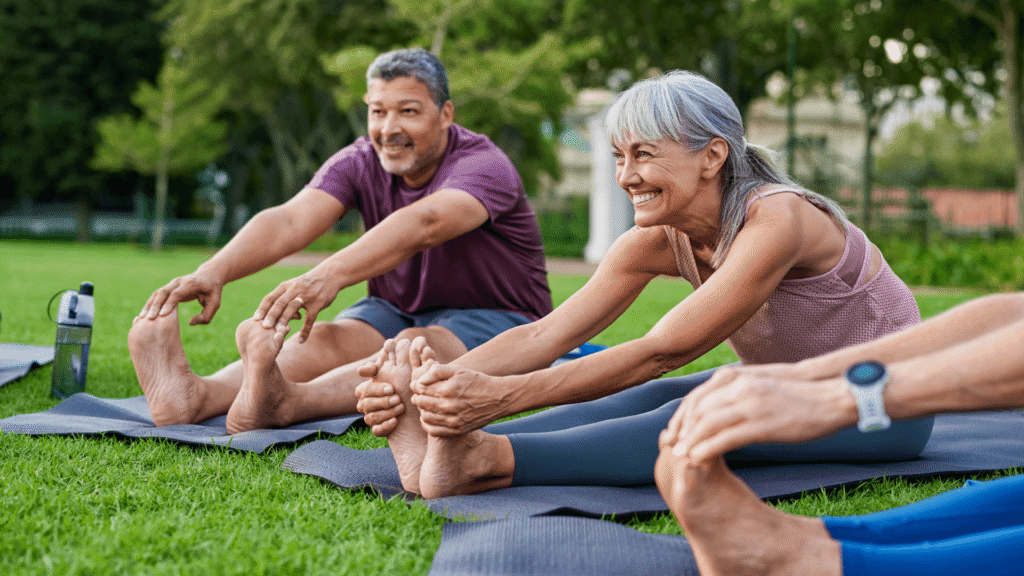
hamstring stretch, quad stretch, chest doorway stretch.
Wrong order equals wrong effect.
Who Needs Stretching the Most?
Honestly? Everyone.
But especially :
- Office workers
- Heavy lifters
- Runners
- Beginners
- Anyone recovering from injury
- People above 40
Tightness doesn’t discriminate.